Adventures of Anette: Language
Showing posts with label Language. Show all posts

Thursday, August 18, 2016

Ask a Teacher - New Norwegianclass101 Language Episodes

9:46:00 PM
When I was studying Japanese at university I used to listen to the language podcasts of a site called japanesepod101.com. With a 40-minute commute to school every day those podcasts were of great help for me to improve my Japanese both in terms of listening skills, vocabulary and grammar. From very beginner level to advanced 四字熟語 I remember their podcasts had it all for me to advance my Japanese and I owe them a big thanks for enabling me to get to my current fluency level.

Japanesepod101 is actually just one of many sites under the umbrella of the company called Innovative Language, and among the many languages they offer there is also a Norwegian language site called norwegianclass101.com.
A little while back I was contacted by a representative from Innovative Language and asked if I wanted to assist them with their new Norwegian language series called "Ask A Teacher" that is scheduled to be published on YouTube this upcoming spring (2017). Thinking about how much I used their Japanese site when I was a university student it was really an honor for me to be asked for this role. Over the last few weeks we've been doing some recordings in their studio and prepared a total of 25 episodes about both the Norwegian language and culture.
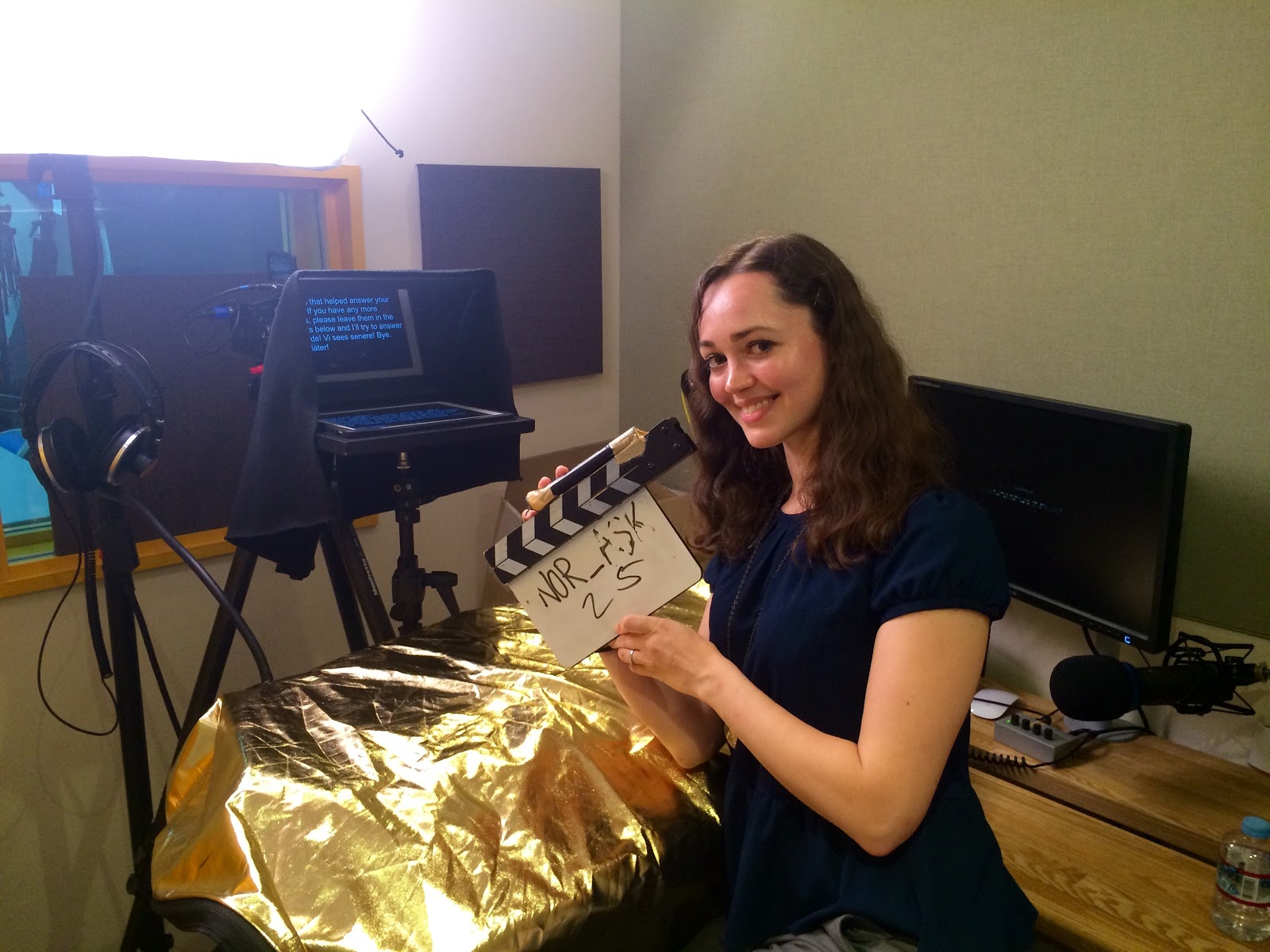
Recording in the studio
It was fun working with the Innovative Language team here in Tokyo, and I'm very excited to see how the result will be! I will share the videos on my blog once the episodes are published so stay tuned for updates :)

Thanks for reading! Please feel free to leave any comments or questions below
- Anette

Related blog posts


Thursday, February 27, 2014

Studying Korean in Tokyo: Seoul Academy

7:00:00 PM
As you probably know, Japanese and Korean are quite similar languages. If you know one of them, it is not too hard to master the other if you only have the time to sit down and study. I already know Japanese to a certain level (passed N1 a couple of years ago, but you know, there's always room for improvement), and this helps me a lot when studying Korean.
My Korean textbook
Right now I'm on my last school vacation, and I figured out that I might as well try to spend the time wisely by taking courses to improve my Korean skills. Although I spent a year as an exchange student at Kyung Hee University in Korea I didn't really have the chance to study the language that much exempt from a three week intensive Korean course I took at Yonsei University last year. This time the intensive course didn't work out with my schedule, but I didn't give up on taking classes in Korean. After some research I discovered a school called Seoul Academy situated in Takadanobaba (高田馬場) that offered various courses at a reasonable price.
I was surprised to find that the Seoul Academy actually was situated on the 11th floor in what used to be a totally normal apartment. At first I was running around the front part of the building looking for the school in the area where all the offices are, so it took a little while before I discovered the entrance.

The entrance to Seoul Academy
I ended up taking one of their 短期集中コース (Short-term focus course). The price was 35.000 yen, and included classes two days a week from 12:00-14:50 (including a 10 minutes break) plus the book we used in class. I was really surprised when my teacher told me I could choose myself whether I preferred group classes or private classes, as I though I would automatically be placed in a group. He told me the price didn't differ, so of course I chose to have private lessons. Lucky!
The reception at Seoul Academy
Our classroom
I had two different teachers on the different days, and because I was the only one in class I got to practice my Korean a lot.! I think that it is advisable to already have a certain level of Japanese before taking the class though, because that is the language you use when your Korean is insufficient. But it is possible that Seoul Academy also has teachers that are fluent in English.
Introduction of the teachers at Seoul Academy
Map to the school
Although the course is over I'm considering taking classes there again once I come back to Japan in the end of March. I'm worried that I'll be too busy since I start working in April, but if not I'll definitely take their courses and try to improve my Korean further.


PS: A little while back I made a PDF with rules for how to translate Japanese words into Korean based on the Chinese characters. This makes it a lot easier to remember Korean words if you already know Japanese (or the other way around of course). Please have a look here if you're interested.

Sunday, February 16, 2014

NEW Kanji to Hanja: 300 words

10:35:00 PM
It's been a year since I promised I would make an updated PDF about how to translate Japanese kanji into Korean based on some simple pronunciation rules. Sorry for the delay! My last year as a student has been pretty busy, but now that I'm on my last school holiday I've finally been able to finish this list!  If you already know Japanese and want to learn Korean (or vice versa) this will come in handy for learning the vocabulary faster. Good luck, and please let me know if you have any comments or if you find mistakes in the document (hopefully there aren't any, but you never know).!
Kanji to Hanja - 300 words

Thanks again to Jostein for the great logo!

Friday, March 1, 2013

Yonsei 3-week Intensive Korean Course: 수료! A summary

12:58:00 PM
Since I came back to Korea in the beginning of February I have been taking daily Korean classes at Yonsei University in Seoul through their 3-week intensive Korean course. Their levels range from one, which is the lowest, to eight. As I mentioned previously I had expected to get into level 3 or something since I only had studies one semester of Korean previously, but ended up in level 5 instead. The other students in my class all seemed to have a lot more experience with Korean than I did, and one of the guys had even lived in Korea for five years. So I did kinda worry that it would be very hard. Which it also was of course, but all in all I think it went pretty well too thanks to a lot of studying in the afternoons. We went through a new chapter every day, which also included two new grammar to memorize, so the progress was fairly rapid.
I have made many new friends both throughout the program at school, and also through the hostel I stayed at in Hongdae, Pencil Guesthouse. I really enjoyed my stay in Seoul, much because of the proximity to everything that Korea has to offer. Last semester I was stuck at school most of the time since my Kyunghee campus is situated far from Seoul, so I even feel that I have experienced more Korean culture during these three weeks than I did during my whole first semester here. During the three-week Korean course we also got to participate in a couple of cultural activities: the first week we learned to play the traditional Korean drum in a Samulnori-course, and the second week we learned how to prepare Korean Bulgogi. Last week all of the students went together to see a non-verbal cooking show called Nanta, which is supposed to be quite famous too. All in all I can definitely recommend taking a language course at Yonsei University. I think it is really nice to have the chance to utilize the winter holiday to learn new or improve old skills!


Other posts:
South Korea
Seoul


Hotels in South Korea

Monday, February 11, 2013

Kanji to Hanja: 100 Words for Rapid Learning

3:01:00 PM

Before I started studying Korean I had heard that the two languages supposedly were quite similar. However, even though I was fluent in Japanese I couldn't really understand anything when I listened to conversations in Korean. After I started studying Korean I noticed that even without using kanji/hanja the Korean language is still based on the same fundamental Chinese characters, which made it interesting for me to search for Japanese and Korean words that had some sort of connection to each other.
I have been working on this list for a little while now, so I really hope you enjoy it. Please let me know what you think ^^

UPDATE: A new extended list with 300 words!


Thanks again to Jostein for the nice logo:D

Saturday, February 9, 2013

Yonsei Intensive Korean Course Week 1!

8:08:00 PM
This week I started following Yonsei University's three week intensive winter course in Korean, and all I can say is that I has been really busy! On the first day of school, which I wrote about in my previous blog post, we had a placement test to determine our Korean level, which I felt went quite alright.. But I didn't really have any expectation in terms of what level I would end up in, as I haven't had the chance to practice that much korean before.
I took a beginner course in Korean at Ritsumeikan University my last semester there, but the progress was really slow.. And even though I have been living in Korea for half a year it is quite limited what you can learn when you study at KyungHee's GIP campus; they do not offer any courses in Korean, it takes 1 1/2 hour to get to Seoul, the campus is in the middle of the forest and even though there are many Korean students there too they all speak perfect English so they aren't too eager to speak Korean to you.. So to put it this way: the interview I did for my placement exam is the longest conversation I have ever had in Korean..
There are eight levels of classes you can get into in Yonsei's winter course, starting from level 1 at the bottom going up to 8 at the top. As you can imagine I had though they would put me in level 2, or maybe level 3 because of my lack of experience with the language. So at Tuesday when I arrived in the lobby with one of my friends from the hostel you can probably also understand how surprised I was when I figured out which level I was in.
I was looking through the list trying to find my own name, starting from level 1and working my way down to level 3 but I couldn't see my name anywhere. As I had been so certain that they'd put me into either one of those levels I automatically thought that there had been an error in the process somewhere, and that they had forgotten to assign me a class. I was just about to storm off to the office when my friend called out for me; she had found my name in group number 5...
The thing is, since I'm fluent in Japanese it makes it very easy for me to learn the Korean words that are based on Chinese characters, which are considered very academic in both Japan and Korea. So I guess it might sound like my Korean is a lot more advanced than it actually is..
Since the other students already have learned a variety of other things about Korean that I haven't have the chance to learn yet I'm kind of lagging behind them a little bit. But at the same time I do feel that my Korean is improving, so I'll just have to do my best and continue to spend my afternoons and evenings memorizing all the stuff! 화이팅!!


Other posts:

Wednesday, June 6, 2012

Hey you with the Kanji Tattoo!

5:27:00 PM
Isn't it funny how we sometimes try to express ourself creatively through foreign languages, such as words our clothing or sometimes even with a tattoo? Some people even use things written in languages they don't know, and where I suppose they have no clue what the writings actually means. Here in Japan there are a lot of people who wears T-shirts or sweaters with text written in English. Which of course is a personal choice, but the problem is that some of the things written does not make any sense: it is often directly mistaken in terms of grammar or spellings. Or even both.

There are T-shirts made with writing in more perifere languages as well, and in a couple of rare incidents you can even find T-shirts in Norwegian (as a girl from such a small country I can't help but pointing this out..)!
My friend and sempai Åse told me about her studies in Japan, and how she had seen a guy at campus with a T-shirt that read: "Jøtul, alle husmødres ønskedrøm". In addition to the text, it had a picture of an old baking oven. 
The funny thing is, Jøtul is the name of a company that sell baking ovens, and "alle husmødres ønskedrøm" means something like "the dream of every housewife" (Literarily "All housemother's wishdream"). Somehow I don't think the guy considered this when he bought the T-shirt..


It is a point though, that by wearing the T-shirt he made the day for both my friend, and also for us others who got to hear the story. There is something nice about seeing people wearing something written in your own language, perhaps especially when the language is quite insignificant in the big world. I was both surprised and happy myself when it turned out one of my Japanese friends at Ritsumeikan had a T-shirt written in something that seems to be Danish/old Norwegian. The text is quite neutral: "Et kamera er et apparat, der benyttes til at affotografere et motiv" (something like "A camera is a device which is used to take pictures of a motif". Although he didn't know the meaning, it made me feel like he somehow was interested in Scandinavia, and it thus gave me an unconsciously positive impression of him. In this sense, you might be able to make new friends just by wearing an interesting T-shirt! (You can see a picture of the T-shirt at the end of this post)


But it is not only Japanese people who like to express themselves through foreign languages; it can also go the opposite way. I got a mail from a friend a couple of weeks ago, which read:
Hi Anette"
Could you help me?
I have a friend, who wants a tattoo with this text: "What doesn't kill me makes me strong.", but he wants it in Japanese... Would you do to translate it for me?"
Although I did have a couple of what I considered to be alright alternatives I asked my Japanese boyfriend how he would translate it. But his answer was simply:
"My answer; don't get a tattoo in Japanese/kanji. It looks funny to the Japanese! Lol."

..And I guess that is the point with this post: although a Japanese tattoo might seem really cool here and now, you should probably think a little about it before you actually get it. Or else, you might end up with a lot of Japanese people laughing behind your back. I mean, a T-shirt can always be taken off if you discover that it didn't really have the desired outcome. On the other hand, that should of course not stop you if you have a kanji you feel would look really cool as a tattoo. After all it's all subjective, and I suppose a lot of people will find it interesting.
But that is just my opinion. What do you think? Is it cool to express yourself with clothes or tattoos written in other languages? Do you have any experiences like the ones above yourself? :)

The coolest T-shirt on campus!! "A camera is a device which is used to take photos of a motif"

Sunday, April 22, 2012

5 Easy Steps to Become Fluent in a New Language

2:26:00 PM
In the modern society it seems that a lot of us are stressing around, either it is school or work that is demanding our time there is simply always something that needs to be done. Even when one has decided to learn a new language it is not always easy to find the time or the right method to actually go through with it, and therefore I have collected some of my favorite ways of learning languages in this post, in hope that it might benefit some of my readers as well.

1. Use your useless time
My father always told me that the ones that gets really good at something, are the ones who practices when others don't. Do you want to learn a new language, but feel that you don't have time? Well, then let me ask you this: Don't you commute to school/work almost every day? Do you clean your house? Do you cook your own dinner? If your answer is yes to any of these questions it means that you certainly have time to learn a foreign language too. All you need, is a listening device, such as an iPod. There are many good programs out there, both pricey ones such as Pimsleur, but also totally free ones too. If you have access to iTunes you should check out their language learning podcasts, which comes in many different languages.
Exchange the music on your iPod for a language podcast, and you can start learning a new language right away!

2. Have fun with it!
There are many ways you can add a bit of language learning to time that would otherwise have been waisted. You can easily use a fun activity, such as watching a movie, to learn a language. Avoid dubbed movies, and go for the real thing! If you need subtitles at first, that's of course fine. It will still make you used to hear the new language, and eventually you will start recognizing words as well. When I was younger I liked to watch English movies with English subtitles. That way I could hear the English words at the same time as I could see how they were written. Nowadays I use http://www.cuevana.tv to watch English dramas with Spanish subtitles, and it gives me a satisfaction knowing that I can pick up new words at the same time I'm enjoying for example a new episode of How I Met Your Mother..

3. Get a tutor!
Learning a new language can be even more fun if you have a friend or a tutor who can help you a bit along the way. Especially if you are in a country where you don't have the chance to practice your desired language on a daily basis, it might be a good thing to get to know somebody who is fluent in the language you want to learn, so that you can ask him/her questions or even have somebody to talk to in the other language. If, however, there is no such person in your vicinity, then don't panic - there is still hope. Livemocha is another great Internet page where you can practice new languages at the same time as you have the chance to communicate with other members from all over the world. This gives you an unique opportunity to get to know people who are willing to help you getting better in whichever language you are interested in.!

4. Drill the vocabulary
However, sooner or later you have to face the fact that you need a lot of vocabulary in order to speak another language. For some languages this part might be easy, especially a lot of European languages are related, and if you already are fluent in Spanish you'll probably find learning French, Italian or Portuguese just a few steps away. However, there will still be new words to learn, and if you - like me - are aiming at completely different languages such as Japanese, Korean or Chinese, then you definitely should make sure you have a good flashcard-program to drill the new words.
Here I would recommend Mnemosyne, which might seem like a normal flashcard program, but where you can rate your answers from 1-6, and the program will automatically repeat the words you are bad at more often. For those out there with iPhone etc, check out the iSRS-application.
With these programs it is possible both making your own flashcards, or to download ready-made vocabulary packs from Mnemosyne's Internet page.

5. Don't be afraid to speak up!
..Which might be easier said then done for a lot of people out there. But the truth is, NOBODY becomes fluent in a foreign language without making mistakes along the way. Just admit it, you will make mistakes along the way whether you like it or not. If you don't try, you'll never make it.


Do you have any other advices for learning foreign languages, or do you simply have a comment about the learning methods mentioned above? Either way, please don't hesitate to leave me a comment!
(^o^)/


About Me

Adventures ofAnette


A modern day shield-maiden who loves to explore the unbeaten paths of the world. From her base in Tokyo, Anette takes on both rural and urban challenges, and goes by the motto "No challenge too big, no adventure too small"!
・Read more →


Recent Posts

recentposts

Random Posts

randomposts