Adventures of Anette: Shrine
Showing posts with label Shrine. Show all posts

Thursday, March 1, 2018

Spring in Tokyo: Plum Blossom Viewing at Ueno's Yushima Tenmangu Shrine (湯島天満宮)

10:54:00 PM
Above: Plum flowers in bloom at Yushima Tengu
Japan is already known worldwide for its beautiful cherry blossom trees blooming around late March until early April in the areas around Tokyo. It is no wonder that this also is when the number of visiting tourists to Japan hits its yearly peak, a number that keeps increasing every year. But did you know that if you visit Japan a little bit earlier you can enjoy the just as beautiful plum flowers that are blooming from the beginning of February to early March?

Sunday, May 8, 2016

Sightseeing in Niigata: The Yahiko Shrine (弥彦神社)

12:59:00 AM

The Yahiko shrine (弥彦神社 or 彌彦神社) in Niigata is situated at the root of the sacred Mt. Yahiko, and surrounded by a forest of 400-500 year old cedar and zelkova trees it is known throughout Niigata as a "power spot". It is one of the most popular shrines in the prefecture, and has a history dating back to around 711 when according to ancient records the main shrine was built.

During my trip to Niigata for the Tsubame Sakura Matsuri festival we made a short visit to the Yahiko shrine, which I have written more about below.

Saturday, February 27, 2016

Sightseeing in Chichibu: The "Power Spot" Mitsumine Shrine (三峰神社)

11:49:00 PM
Just a couple of hours by train from Tokyo lies the historic little village Chichibu (秩父). Referred to by some people (especially if you talk to locals) as “Kanto's Tibet” this place holds an interesting history reaching back more than 2000 years. One of Chichibu’s most famous tourist spots is the Mitsumine Shrine (三峰神社), which is hidden far away up in the mountains behind Chichibu.

Saturday, November 14, 2015

Sightseeing in Nikko: A Visit to the World Heritage listed Toshogu Shrine (東照宮)

3:06:00 PM
Japan has numerous hidden gems outside the so-called “golden route” stretching from the ancient capital of Kyoto to the bustling metropolis of Tokyo. The city of Nikko is one of the many gems situated outside of the the typical tourist route that has become well-known throughout the whole world. Just a couple of hours by train north of Tokyo you can find Nikko and its famous UNESCO World Heritage Sites including the magnificent Tōshōgū Shrine (東照宮). In addition to its sheer beauty the shrine attracts tourists from all over the world as the place where one can visit the final resting spot of the Tokugawa Shogunate's founder, Tokugawa Ieyasu. If you're planning on a trip to Nikko then the Tōshōgū Shrine is without a doubt a must to visit.

Sunday, February 9, 2014

Tokyo covered in Snow!

9:15:00 PM

Yesterday it snowed the whole day here in Tokyo, and the area where I live has been turned into a winter wonderland. Here are some of the pictures I took of my neighborhood.!

A shrine covered in snow
From inside the shrine area
The white streets
Flowers in the snow
And.. Surprise! More snow..
Melted snow
The carrousel at Tokyo Dome City also covered in snow
In the evening I went to Shibuya to meet up with some friends, and while I was there I took some really cool photos of Hachiko covered in snow. Only thing is, I had uploaded these pictures to my computer earlier that day, and I had forgotten to put the memory card back into the camera. Didn't realize until later when I wanted to take a look at the photos I thought I had taken. Ahh.. Oh well, at least I got some nice ones of the snow in the morning..

Related blogposts


Recommended Hotels in Tokyo

Royal Park Hotel The Shiodome
Bunka Hostel Tokyo
Bunka Hostel
Tokyo
Sotetsu Fresa Inn Nihombashi-Ningyocho
Sotetsu Fresa Inn Nihombashi
Ryokan Asakusa Shigetsu Hotel

Tuesday, July 9, 2013

Sightseeing in Kyoto: Kitano Tenmangu Flea Market

12:57:00 PM
Although I lived in Kyoto for two years as an exchange student to I never had the chance to visit Kitano Tenmangu (北野天満宮)'s monthly flea-market even once (although I visited the shrine during one of their autumn light-up events at the Kitano Tenmangu garden).
Now I'm back in Japan for work, and before moving to Tokyo I spent a week in Kyoto, during which I finally got myself together and went to the "Tenjin-san" (天神さん) flea market  to take a look at what kind of things they were selling there.

Wednesday, July 25, 2012

Fuku Musume (福娘): The Children's Ebisu Festival 子供戎祭

5:18:00 PM

Adorable kids' drawings at the shrine
As a Fukumusume I got the chance to participate in the Children's Ebisu Festival in the Imamiya-Ebiu shrine this weekend. The "Kodomo Ebisu" is Imamiya Ebisu shrine's summer festival, and it is held annually around the last weekend of July. A lot of children come to visit with their parents to play and have fun, so the shrine is filled with a pleasant atmosphere. It is quite interesting how different the shrine looked compared to the Tōka Ebisu festival in January, one could almost mistakenly think that they were two different places..
My role on the first day was helping out by the fishing dam. The kids all got a rod which they used to fish paper fishes (and animals) with, and the kids could get candy if they were lucky and got a fish with the note 当たり on it.
Kids trying to catch the paper fishes!
The fishing dam
A somewhat blurry picture of our group of Fuku Musume-girls in action at the festival.

In addition to the fishing dam there were also a whole load of other activities for the kids as well. On the stage they were having dancing and balloon shows, and the kids looked like they were having a lot of fun. On the second day of the festival me and three of the other Fuku Musume-girls got the honor of opening the snow slide, and the rest of the day we helped out with one of the ballgames.
The snow slide at the Kodomo Ebisu Matsuri seen from the top!
Since I was working at the festival it wasn't easy to take a lot of photos though. I had to use my iPhone 3G, which just doesn't take that good pictures.. Here are some photos taken with my normal camera after all the kids had gone home:
Drawings made by kids used to decorate the shrine
The main temple in the shrine. 
The fishing dam after all the children have gone home..
The Kodomo Ebisu festival was quite fun to participate in, and it was nice to be back in the shrine too as I've got some good memories from my work there during the Toka Ebisu festival in January. The Imamiya Ebisu shrine sure has some cool festivals^^! Lastly, here is a short video from the festival:


Place Imamiya Ebisu Shrine (今宮戎神社)
Map
Festival The Children's Ebisu Festival (子供戎祭り)
held annually during the last weekend of July
Access A couple of minutes walk from the Imamiyaebisu station
(今宮戎) or around 5 minutes from Daikokucho (大国町) station


Recommended Hotels in Osaka

Osaka Marriott Miyako Hotel
Superhotel Lohas Honmachi
Khaosan World Namba
Khaosan World Namba
The St. Regis Osaka Hotel

Related blogposts

Thursday, April 12, 2012

Spring in Japan: Sakura Season and Hanami in Kyoto!

8:04:00 AM
One quite particular thing about the Japanese culture, is how they like things that are pretty, but at the same time things that are fragile or fugitive, or in other ways imperfect. Perhaps that is why they like the sakura  桜 (cherry blossom) so much.. Every year the trees brings new and beautiful flowers, but the flowers only lasts for a couple of weeks, until their petals falls to the ground. If there is a heavy rain the long-awaited hanami might even get washed away along with the flowers. The sakura is a sign of spring, and Japanese people (as well as us foreigners) likes to gather in parks/shrines/etc to drink with friends and watch the pretty flowers. This event is called hanami, and it literarily means to "look at flowers" (花見). Like last year I have already been to a couple of hanami-events, and the pictures in this blog is from the hanami I went to with the Study in Kyoto Program (SKP)-students in the Maruyama-park (円山公園) behind Yasaka Jinja. 
Compared to last year the sakura flowers bloomed really late, so I didn't get that many good shots this time. Anyway, thanks for reading my post, I'll be back with more soon;)
Sakura over a gate in Gion
One of the traditional streets in Gion
During hanami there are a lot of stalls where one can by small portions of different types of Japanese food, such as takoyakiokonomiyaki, etc etc. Here is the stalls + the sakura
Nanzen-ji 南禅寺
Students ready for hanami
A group picture with some of my fellow students
Another 集合写真 with more or less all the hanami participants
The Yasaka-jinja exit

Related blogposts


Thanks for reading! Feel free to leave me a comment or question below!
~Anette

Wednesday, February 29, 2012

Sightseeing in Bali: Daytrip to Ubud & Don Antonio Blanco's Museum

10:23:00 PM
Typical Balinese style entrance
After some nice days in Yogyakarta it was time to leave for a new destination again, and this time we were heading towards the famous tourist-island Bali. We had decided to go there by bus, and left Yogyakarta the same afternoon as we had gone sightseeing to Borobudur and Prambanan temple. The trip was rather long though: it took us over 20 hours until we could finally leave the bus in Denpasar, Bali. And from there we took the taxi for about half an hour to get to Kuta beach, where we had decided to stay while in Bali.
The day we arrived we didn't do that much, I tried to surf for the first time and beside that we just relaxed and checked out the area we lived in. We did however meet an Australian/English couple who had rented a car for 400.000 Rp for the following day, and they asked us if we wanted to join them, split the bill and go to Ubud in the morning. We decided to come along, and the following day we got up early and left for Ubud with our new friends. They are both retired, and had been to Bali on holiday many times already. John, who was Australian, wanted to visit the museum of a painter he had got to know in Bali many years ago. The painter, Don Antonio Blanco, is probably the most famous artist that has ever lived in Bali. Although Blanco lived in Bali most of his grown-up life he was actually born in the Philippines, and his parents were both Spanish. In the end he settled down in Campuan in Ubud, and he lived there with his wife, a famous Balinese dancer. Their home has been made into a museum by their son Mario, and we went there to take a look at his gallery and paintings.
A Shiva-statue in the garden
A group picture with John's wife, our driver, me and Yuma.
 Blanco's property also had a big garden where we spent some time. Seems Blanco must have really liked birds, because there are still a lot of birds being kept in cages here, along with some parrots who are tamed. We got to hold them too, they were soo cute:)

Nice parrots!
Yuma + parrots
After a trip around the garden we went to see the main museum where Blanco's paintings were. The entrance to the museum had a very special gate: a big statue of Blanco's logo, which he apparently made based upon his own autograph.
The entrance to Blanco's art gallery
A dragon statue at the entrance to the gallery
 Unfortunately it's not alowed to take any photos inside the main gallery, but for those interested in Blanco's paintings I suggest that you check out the homepage of the gallery.
A statue on the roof of the main gallery
A painting surrounded by tools in one of the rooms in the galleri

Blanco's family shrine
In addition to the garden and the art galleries the Blanco family also had their own shrine. We stopped by and left the flowers we got when we entered there. 
We left the flowers we had gotten in the family shrine
 After the visit to the museum we went to see Ubud's characteristic rice paddies. The view there was very pretty, with the houses clinging to the hills. Even though this place is popular among tourists it still feels somewhat like being in an authentic Balinese village.
Ubud's famous rice paddies
They sell beautiful items made of wood here too.
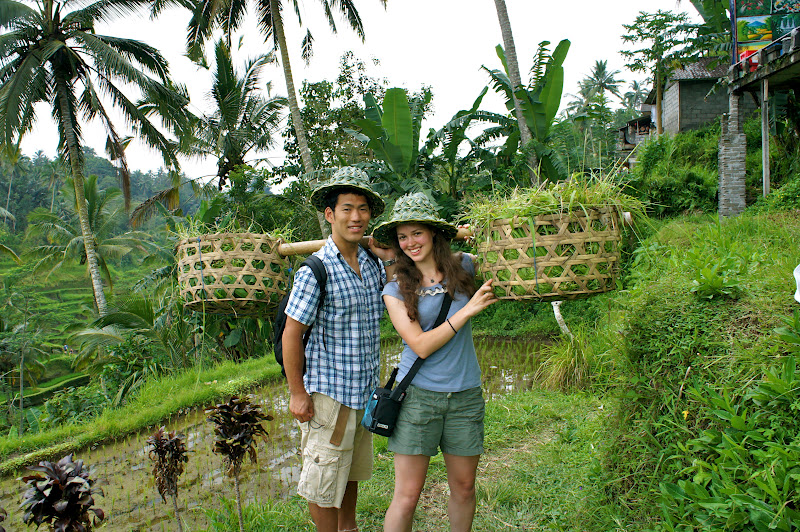
Ubud is known as a place for original and beautiful art, and you can also find cheap handicrafts here. The locals will probably be all over you trying to sell you stuff, and they try to catch your attention by telling you that the price on their items is as low as one dollar. However, if you show your interest you will soon discover that they do not intend to let you get the items that cheap.. In the rice fields you can also see workers in action, and if you give them some money you can take photos with them or with their rice baskets.

Tourists almost gets run over by locals who are trying to sell their products. 
Yuma & me, local style^^
Souvenirs and rice fields
The trip to Ubud was a good one, and we went back to Kuta with both a lot of nice photos and good memories too. The only part that didn't turn out as planned, was that originally we had planned to try out yoga in Ubud too, but unfortunately we missed our chance this time. Oh well, just another reason to come back in the future;)


Related blogposts


Recommended Hotels in Bali

Bisma Eight Ubud
Bisma Eight 
Ubud
Dedari Kriyamaha Villas
Kupu Kupu Barong Villas & Spa by L'Occitane
Kupu Kupu Barong Villas & Spa
Komaneka at Bisma Ubud

About Me

Adventures ofAnette


A modern day shield-maiden who loves to explore the unbeaten paths of the world. From her base in Tokyo, Anette takes on both rural and urban challenges, and goes by the motto "No challenge too big, no adventure too small"!
・Read more →


Recent Posts

recentposts

Random Posts

randomposts