Adventures of Anette: Kimono
Showing posts with label Kimono. Show all posts

Tuesday, September 23, 2025

15 Years in Japan: A Life Between Cultures

6:10:00 PM

Fifteen years ago, I arrived in Japan with a suitcase full of dreams and not much else. I knew almost nothing of the language, even less of the cultural codes, and had only a vague idea of how long I would actually stay.

As it turns out, 15 years go by pretty fast.

I’ve experienced so much since then. I’ve danced in local summer festivals, worn kimono for ceremonies I once only saw in movies, and slowly, layer by layer, built a life here that feels strangely — beautifully — like my own. Japan, with all its seasons and silences, became home in ways I couldn’t have planned for.

But despite all of that... I still mess up. Regularly. Often with just enough flair to remind myself: “Ah yes, you are still an outsider.”

Here are a few of my greatest hits:

  • Shinjuku Station? I somehow keep convincing myself I’ve mastered it. And yet, I still end up at the wrong platform, walking in tight circles, muttering “this is impossible” under my breath.

  • Going cashless like a Tokyo local… until I have to awkwardly ask the table next to me at a café if they can sell me ¥1000 via PayPay. (Bless them, they did.)

  • Boarding the right train, in the wrong kind. Because in Japan, a train can go in the right direction… and still skip your stop entirely.

  • Sunburn at Izu Beach in September. Every year, I underestimate the Japanese sun. Every year, the sun wins.

Even after 15 years, these small embarrassments make me laugh. They remind me how deep — and how delightful — the culture here can be. Living in Japan is like learning a language you’ll never fully finish. But that’s also part of the charm, isn’t it?

What I’ve gained over these years goes far beyond what can be photographed or posted. It’s in the gentle nods from neighbors, the seasonal greetings at the post office, the tiny shrines on street corners I pass every day and still sometimes stop at.

It’s also in the friendships — both old and new — that carried me through hard winters and hot summers. Some of you have been part of this journey from the very beginning, others I’ve met along the way. Either way, I’m grateful beyond words.

To Japan — thank you for these 15 years. To everyone who has been part of it — thank you, truly. Here's to whatever comes next. ✨


👘 15 years of kimono memories
🫶 One heart, very full

Thursday, June 8, 2017

Tokyo Sightseeing: A Day with Kimono Rental in Asakusa

10:26:00 PM

One of the things that can be recommended as a cultural experience for people visiting Japan is to combine a day sightseeing with trying to wear the traditional Japanese clothing kimono or yukata. Even for Japanese people wearing a kimono is not something you have the chance to every day, and even most Japanese people only were kimono for special occasions a couple of times a year. 

Saturday, March 18, 2017

Sightseeing in Saitama: Day Trip with Kimono Rental in Kawagoe

5:10:00 PM
Just a 30 minutes train ride from Ikebukuro in the northern part of Tokyo lies Kawagoe, a charming little town in Saitama prefecture. You’ll be surprised to find that this little town once was a flourishing castle town, and that it still contains a large collection of houses dating back to the Edo period – this has in fact helped Kawagoe gain its nickname “Little Edo” (子江戸). I have had the pleasure of visiting Kawagoe a number of times through my job as a hotel consultant, but this time was my first time to enjoy the atmosphere of the traditional area of Kawagoe while wearing the traditional Japanese outfit kimono.

Monday, November 23, 2015

Try it yourself: An Oiran (花魁) Cosplay Experience in Japan

6:16:00 AM
Most people have heard about the Japanese escort ladies called geisha, known in the West through for instance the world famous book & movie “Memoirs of a Geisha”.
Throughout history there have however been other types of Japanese escort ladies, and the forerunner to the Japanese geisha is known as oiran 'woman of pleasure'. 
Oiran was a popular profession during the Edo period (1600~1868). Back in the early days of the Edo period the Oiran were considered high class courtesans, and unlike yūjo (遊女) prostitutes they were first and foremost entertainers with refined skills in a number of traditional arts such as sadō (Japanese tea ceremony), shamisen (three-stringed Japanese bajo), ikebana (flower arranging), and calligraphy. Elegant as they were, some Oiran women even went on to become famous outside of their daily workplace, and have inspired various Japanese fashion trends throughout the years.

The word oiran comes from an abbriviation of the sentence "Oira no tokoro no nēsan" (おいらの所の姉さん), which can be translated into "my elder sister". The kanji characters used to express this word are "flower" (花) and to "charge ahead of others" (魁). 

Although Oiran is a tradition of the past that ended with the rise of the geisha and later almost disappeared along with strict laws enforced to stop prostitution there are still people who are working to keep the tradition alive. But a big difference from the past is that today women dress up oiran style in order to preserve a cultural heritage or to entertain rather than having it as a profession or lifestyle, and it does not include sexual services anymore. I've written more about the difference between Oiran and Geisha here.

Even though it no longer is a common profession nor holds the popularity it used to have in the past one can still find extremely popular events and festivals dedicated to oiran, such as for instance the Bunsui Sakura Matsuri Oiran Dōchū that is held every year in Tsubame, Niigata. 

The vivid and colorful style also keeps attracting people who are interested in Japanese fashion and traditional arts in general. As a result of this popularity there are also a growing number of companies out there offering people who are interested the chance to try on the oiran outfit themselves.

La Petit Fleur in Oukurayama
As you've probably noticed from the pictures above I recently had the honor of getting dressed up in a oiran style kimono. This opportunity came through a company called Workshop Japan, who's goal is to help introduce Japanese culture to foreign visitors. In addition to offering oiran cosplay they also hold various other workshops that foreigners can attend, such as Kazari-maki-zushi(Art Sushi Roll) cooking class and Japanese calligraphy.

The Oiran cosplay experience was a cooperation between Workshop Japan, a flower shop & cafe at Oukurayama in Yokohama called La Petit Fleur café and last but not least the makeup artist Candy Blue. La Petit Café was used as the location for the photo shoot, and Candy Blue (artist name) was in charge of the kimono and makeup. She styled me according to the season, and since it was autumn I got to try out a kimono with red autumn leaves in my hair. Here are some more photos from the experience (these ones are all taken with my phone so the quality is not as good as the ones that Workshop Japan took):


Getting to try out Oiran cosplay was a totally new experience for me. I previously had the chance to do some wedding modeling while in Japan, both with kimono and more modern style Japanese dresses, but this time the vibe was quite different, especially as one usually would associate wearing a kimono with being kawaii rather than sensual.


As Candy Blue is mainly focusing on body jewelry you can notice the detailed decoration on my shoulder. These are stickers, all hand-made by Candy Blue herself. The devil is in the detail, and the team did their utmost to make sure that everything was perfect for the shooting.


After the shooting was done the crew printed out a couple of the pictures they had taken and gave them to me in a cute album with sakura-design that they gave me on the spot. The whole experience was very professional, and besides all the nice photos I got another great memory from Japan.

One of the pictures from the shooting being used on a Workshop Japan pamphlet. (Credit: Candy Blue) 
Workshop Japan is taking reservations from any travelers and expats who want to get dressed up oiran style. If you're in the area and interested in this opportunity, please check out the following links:


Finally, please note that this is oiran cosplay and not necessarily an exact depiction of how oiran were dressed. If you're interested in the real thing please check out this post where I've written about my experience as the first foreigner participating as an oiran in the Tsubame Sakura festival.


Related blogposts

Tuesday, May 8, 2012

Modeling for Kyoto Weddings: My Japanese Wedding, or the day I (Almost) Married a Stranger

5:00:00 PM
I looked deep into his eyes, and he looked back at me. I was beautifully dressed up in a Japanese wedding-kimono with vivid colors, and flowers in my hair. Both of us were smiling broadly, and to a stranger it would seem like we were very much in love.
But I had never seen this guy before in my life..

The whole thing started a couple of weeks ago, when my friend Dan told me that he had a friend looking for somebody who could help him and his company, Kyoto Weddings, with a photo shot. More precisely, they were looking for westerners who could do some modeling for a bridal shot they would use to market the company on their homepage. I thought it sounded like a fun experience, so I didn't wait long with sending an email to the friend, Eric, telling him that I would love to help out. I was over myself with excitement when I got a replay saying that they wanted me to do the job. It was the beginning of April, and this time of the year is famous among both Japanese as well as foreigners for the pretty sakura (cherry blossoms) that are in full bloom in Japan, usually in the month's first couple of weeks. In other words, being a wedding model in Japan in April must be one of the coolest experiences a student in Japan could possibly get.
Photo shoot in a traditional Japanese room
A couple of weeks later I met up at Kyoto Wedding's main office in downtown Kyoto, ready to be styled up. The professional team was ready for action, and before I knew it they had fixed my hair, done my make-up and even dressed me up in the stylish wedding-kimono. I almost felt unrecognizable in the pretty kimono and with the flowers in my hair; I was like a little porcelain doll. I'm still amazed by how fast everything was done.. If I should have fixed all that myself it would surly have taken all day and still not look half as good. After the styling was finished the work of the day started with photos taken in the studio's traditional Japanese room.
After a little while I was joined by my groom-for-the-day; a tall and handsome-looking guy who turned out to be Swedish. Although it was a bit awkward doing romantic photo shootings with a guy I hadn't even met before, it turned out to be quite a funny experience after all. I guess it helped a bit that he was Swedish too, as it felt more comfortable being able to communicate in our own language (Swedish and Norwegian is actually pretty close, so unless you use a very strange dialect the other person will usually have few problems understanding what you are saying). That made the situation more relaxed, and adding that Marcus was a really funny guy he turned out to be a really great match as a one-day groom. Haha..
Me and my Swedish groom-for-the-day
After about an hour of photo-shooting in the studio we were escorted out of the building, where a special wedding limousine was waiting for us. Here you might think that a Japanese wedding limousine is like any other limousine, but there are in fact 3 features that are special to a Japanese bridal car, according to the description from Kyoto Wedding's blog:

1. There is a Chinese character for happiness painted on the car
2. Besides the doors, the roof of the backseats also open to make room for the Japanese bride's kimono and hood
3. To help the bride, there are reins on the back of the front seats for her to balance herself with

Ready for more photographing in the Japanese wedding limousine
From Kyoto Wedding's studio we drove towards an area in Kyoto called Gion (祇園), which among other things is famous for its traditional Japanese streets. This, and other places in the east part of Kyoto, was where we were going to do the photo shooting of the day, and with the cherry blossoms blooming and a light layer of clouds in the sky the setting was perfect for getting good pictures.
Walking down the streets of Gion it seemed like we had become celebrities in just a couple of minutes. We were basically stalked around by a group of people who wanted to take our photos, and this group mainly consisted of Japanese ladies in their 60s. It was quite funny, but embarrassing at the same time, when some of the local ladies asked our crew if we actually had gotten married, and they answered yes. Which resulted in a lot of congratulations from the viewers. If it weren't for the make-up on my face I would have been red as a tomato right then and there..
Also, we weren't the only couple walking around in Gion getting their wedding photos taken that day. There was a Japanese couple there too (probably not a fake wedding like ours), but with us around it didn't seem like they got a lot of attention at all. Which kinda made me feel a bit sorry for them, since they were the ones who actually was celebrating their wedding day.. I guess the people in Gion found it more amusing with foreigners dressed up in kimono than the real Japanese bridal couple..?

On the bridge on the way to the Heian Jingu-shrine 
We went around taking photos for a couple of hours before ending the day with a quick lunch back at the studio. It was a bit sad having to leave the pretty kimono behind and going back to my normal "boring" clothes. I had a really fun day being a bridal model for Kyoto Weddings, and this is definitely one of the most memorable experiences I have had during my almost two years in Japan. In the future I'll hopefully have the chance to get married for real, and if the wedding is going to be in Japan then I have no doubt about who I'm going to contact..

Thanks again to Kyoto Weddings for a fantastic day, and not to mention the beautiful pictures!

My groom-for-the-day Marcus and our team from Kyoto Weddings
More info about Kyoto Weddings and their services can be found at their webpage.!


Related blogposts

Wednesday, April 18, 2012

Trying out the Kimono Club @ Ritsumeikan

10:27:00 PM
As I have explained about earlier in one of my post, it is quite typical for Japanese students to join a so-called circle (サークル) or club where they can practice things they like, or have an interest in. I just got myself a kimono a couple of months ago thanks to the Toka-Ebisu festival I participated in, so one of the things I really wanted to try out this semester was a club that could teach me how to actually put the kimono on by myself.
During the orientation week at Ritsumeikan I got the contact information to the leader of the kimono-club (circle), and I contacted her and asked if it was ok if I participated. Luckily it was, and so I dragged along my friend Larissa in the last moment to check it out! Turned out there were quite a lot of students interested in trying out the club, and for our first day we all got the chance to get dressed up by the other girls who already had been members for a semester or more.
Getting ready for kimono! 
Larissa gets help with her kimono
Both of us all dressed up! Yay!

Almost done!
Photo time!
Some of the kimonos you might end up wearing if you join the kimono-club
It was really nice to try out the kimono-club, and the members were friendly too. We did feel welcome, and I would have liked to continuing going to the club if it weren't for my shoulder. I haven't really decided what to do yet, but I do think that I'll have problems putting the kimono on because the movement of my arm still is quite limited x(
Anyway, it seems like a good club! If you become able to put on the kimono by yourself they might even let you lend the kimono some time! Would be nice for instance if you want to walk around in Kyoto in kimono, wear kimono at a hanami or something like that^^..


Some more facts about the kimono-club:
Membership: 6000 yen for a year
Meetings: Every Wednesday
Contact information can be found on Ritsumeikan's home page!

Saturday, January 14, 2012

Fuku Musume (福娘): Behind the Scene of Osaka's Touka Ebisu Festival (十日戎)

11:46:00 PM

The Imamiya Ebisu Jinja shrine (今宮戎神社) in Osaka, where the Tōka-Ebisu Festival (十日戎) takes place 
ようお参りです!
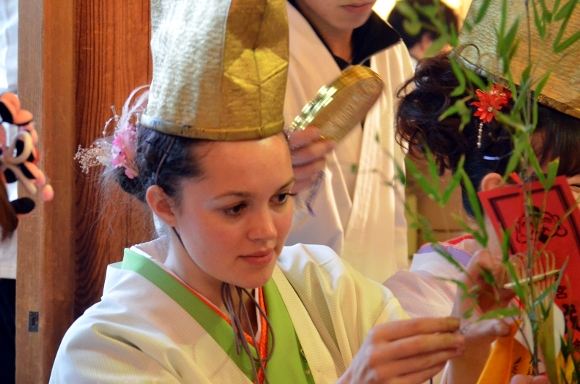
In the end of last year I was elected as one of 50 girls (out of almost 3000 applicants) to serve as a shrine maiden in the Imamiya Ebisu Jinja - shrine in Osaka during the famous Tōka Ebisu Festival which is being held from the 9th until the 11th of January. But it didn't end there. In fact, out of the 50 elected girls there was another round of competition where I was among the 4 girls who got the honor of representing the Fuku Musume girls as a so-called Fukumusume Daihyo (福娘代表, meaning Fukumusume Representative).
Me in front of a Tōka-Ebisu poster

Just being elected as a Fuku Musume in itelf is however a great honor, so you can imagine I was happy..! The Tōka-Ebisu festival is one of the most famous festivals in Osaka, and it attracts as many as a million visitors each year. Not too surprising, considering that the festival has been celebrated more or less annually since the Edo-period (Between the 17th and 19th Century).
In this blogpost I'm going to write about my experiences during the Tōka-Ebisu Festival.
Some of the items being sold at the festival
Imamiya Ebisu decorated with lanterns and pictures
But first, a little bit of background information. This festival is celebrated to honor the god of good fortune, known as Ebisu or Ebessan among people from Osaka. In order to get luck for their businesses and loads of money in the following year, a lot of people find their way to the shrine during these three days. Our job as Fuku Musume was to sell them lucky charms, which we then attached to branches of bamboo which the visitors had gotten for free in the shrine area before approaching us. Of course you are expected to speak to the customers in polite Japanese, preferably Keigo. There are however some set phrases which are not being used in a normal store; for instance you can greet the visitors with "yō omairi desu" instead of the commonly used "irasshaimase", and when they leave you simply make this phrase into past tense (yō omairi deshita).

Visitors coming to buy lucky charms
The days were pretty long: we had to meet at 8:30 in the morning and then we worked almost non-stop until 9 in the evening. That is to say, we did get one lunch- and one dinner break a day though, both 20 minutes long. Which is quite short and stressful, since it included both the time to eat and necessary toilet breaks. The Eboshi-hat and the cape are considered holy, so you have to remove them before you can use the bathroom or go to lunch, and it usually takes some time getting everything both on and off. Further, there are only 3 toilets, and often a line of girls who wants to use them. And trust me; waiting in line does not give you extra minutes for your lunch breaks. In other words, I'm pretty sure it is virtually impossible to keep the time limit unless you refrain from eating most of your bento. Fortunately they are not that strict with the exchange students group, but for the Japanese girls they are taking the time and keeping a record of the girls, covering all their meals on a big board. Either you enter as an exchange student or in the same group as the Japanese girls you better be prepared to eat fast..!
Cameras ready!
The first two days went by pretty fast; but as a Representative Fuku Musume (福娘代表) I got a couple of extra breaks to participate in TV interviews. Lucky! I mean, although it is fun with the work in general, the day can be a bit long since you basically do the same all day. And of course being interviewed is fun too^^.. The only difference I noticed in the work between Daihyou Fuku Musume and the other Fuku Musume girls is basically that the four Daihyou girls are the ones who talks with the press.
From one of the Fuku Musume TV interviews
On the second day they are also having a palanquin parade called Hoekago (宝恵駕籠行列), which are one of the highlights of the festival. However, unfortunately only the Japanese Fuku Musume girls got to participate in the big parade; us exchange students had a normal working day at the shrine.
Attaching lucky charms to a bamboo branch
I did meet a lot of friendly and interesting people during the 3 days of the festival. Some of my friends who came to visit me in the shrine could however not find me because of all the people (most likely I must have been on a lunch break or something, we are naturally not allowed to carry mobile phones during the working day so it's not exactly easy to contact people).. But besides our friends who came to support us, there were a lot of people who wanted to take pictures of us or shake our hands. Some people had seen me on TV and actually came only because they wanted to see me. One guy asked me where I come from, and when I answered that I am Norwegian he told me that it was perfect, because he was running an Italian restaurant.. Haha.. Well, at least I'm from the right continent! ;p In short, there is a lot going on during the three days of the festival! The last day I must admit was a bit long though, most of all because it was freaking cold! And because we did not do any interviews either.. The other days there were also a lot more people, so we did not really have time to get bored.
Anyway, here are some of my photos taken backstage:
Obi (帯)
Seen from the side. The hat is called an Eboshi (烏帽子)
The Fuku Musume girls waiting for their turn to start working
As foreigners we are quite lucky, because they have assistants helping us put on our kimonos..!!
The process of putting on the kimono sure takes time! Luckily there are some places where they offer courses in how to put kimonos on, and I definately think I should join one of those courses..
Some of the assistants going through the days schedule etc.
Group picture time!
Most of the Ristumeikan-組
The day might be long, but when you have people who are there for you it makes the time go by faster.
For those of you who might be interested in applying next year, all I can say is that you have to be prepared to work hard. It might be quite stressful at times, and the days are certainly quite long, but I promise you will have a lot of fun too! Zehi gambatte kudasai:)


商売繁盛で笹持ってこい!


Stands outside the shrine area selling lucky items

Recommended Hotels in Osaka

Osaka Marriott Miyako Hotel
Superhotel Lohas Honmachi
Khaosan World Namba
Khaosan World Namba
The St. Regis Osaka Hotel


Related blogposts


About Me

Adventures ofAnette


A modern day shield-maiden who loves to explore the unbeaten paths of the world. From her base in Tokyo, Anette takes on both rural and urban challenges, and goes by the motto "No challenge too big, no adventure too small"!
・Read more →


Recent Posts

recentposts

Random Posts

randomposts