Adventures of Anette: Mt. Fuji
Showing posts with label Mt. Fuji. Show all posts

Monday, July 4, 2016

Sightseeing in Shizuoka: Fuji Safari Park

8:00:00 AM
A giraffe in front of Mt. Fuji (taken from Fuji Safari Park's homepage)
For people wanting to see the sacred Mt. Fuji while in Japan it is possible to combine the trip with other activities in the vicinity, and a visit to Fuji Safari Park might be an enjoyable option for both young and old travelers. The park is located in Susano in Shizuoka Prefecture, and can be reached by car from Tokyo in about 1 hour 45 minutes so it is also an option for a day trip if you don't want to spend the night. Last weekend I and some friends stopped by the safari park as a part of our trip to Shizuoka where our main goal was to go paragliding with Mt. Fuji in the background.

Wednesday, June 29, 2016

Paragliding in Japan: Panorama View of Mt. Fuji with Sky Asagiri (スカイ朝霧)

11:46:00 PM

Paragliding & Mt. Fuji. From Sky Asagiri's homepage
For many people, Mt. Fuji, or Fujisan (富士山) in Japanese, is one of the primary symbols of Japan. People have come from near and far to climb the sacred Mt. Fuji almost from the beginning of time, and after it became recognized as a World Heritage site in 2013 the number of visiting tourists have skyrocketed. If you find yourself in the area and are looking for a unique way to enjoy the view of Mt. Fuji (and you're more of the daring type) you might want to consider to go paragliding with the beautiful volcano in the backdrop.

Monday, April 25, 2016

Hiking in Yamanashi: The view of Mt. Fuji from Mt. Iwadonosan to Chigo-Otoshi

4:00:00 PM

In my previous post I wrote about sakura viewing at Maruyama Kouen (丸山公園), a park located on Mt. Iwadonosan where you find what is said to be Japan's best view of Mt. Fuji. For people who would like to do some more hiking than just the 20 minutes long walk to the castle it is possible to continue by foot up to the top of Mt. Iwadonosan. 

Sunday, April 24, 2016

Mt. Fuji & Sakura Viewing: Maruyama Kouen (丸山公園) and Iwadono Castle (岩殿城)

4:11:00 PM
From the Ootsuki Tourism Association
If you're visiting Japan during spring you’re probably keen to get a good look at the sakura, Japan's unofficial national flower. While the spots where you can view cherry blossoms in Tokyo usually are extremely crowded you can find many equally or more beautifully picturesque sakura spots in the areas close to the metropolis. And then again, as a tourist you might want to combine the view of the sakura with other things that are typical for Japan. If that is the case then I would recommend a trip to Yamanashi Prefecture to see Mt. Fuji from Mt. Iwadonosan.

Sunday, November 10, 2013

Traveling Japan: Mt. Fuji and its Vicinity

5:24:00 PM
Earlier this year Mt. Fuji was included in UNESCO's World Heritage List, making it Japan's 17th site on the list. As result the old volcano has experienced increased popularity, and not surprisingly the number of climbers who want to reach the top of Mt. Fuji is also on a rise. But although the view from Mt. Fuji is supposed to be very nice (when I climbed Mt. Fuji last year the weather was so bad we could not see much besides the heavy clouds), it is perhaps even better to climb one of the nearby mountain to take a look at Mt. Fuji from afar.
Mt. Fuji seen from the camping area by lake Motosuko
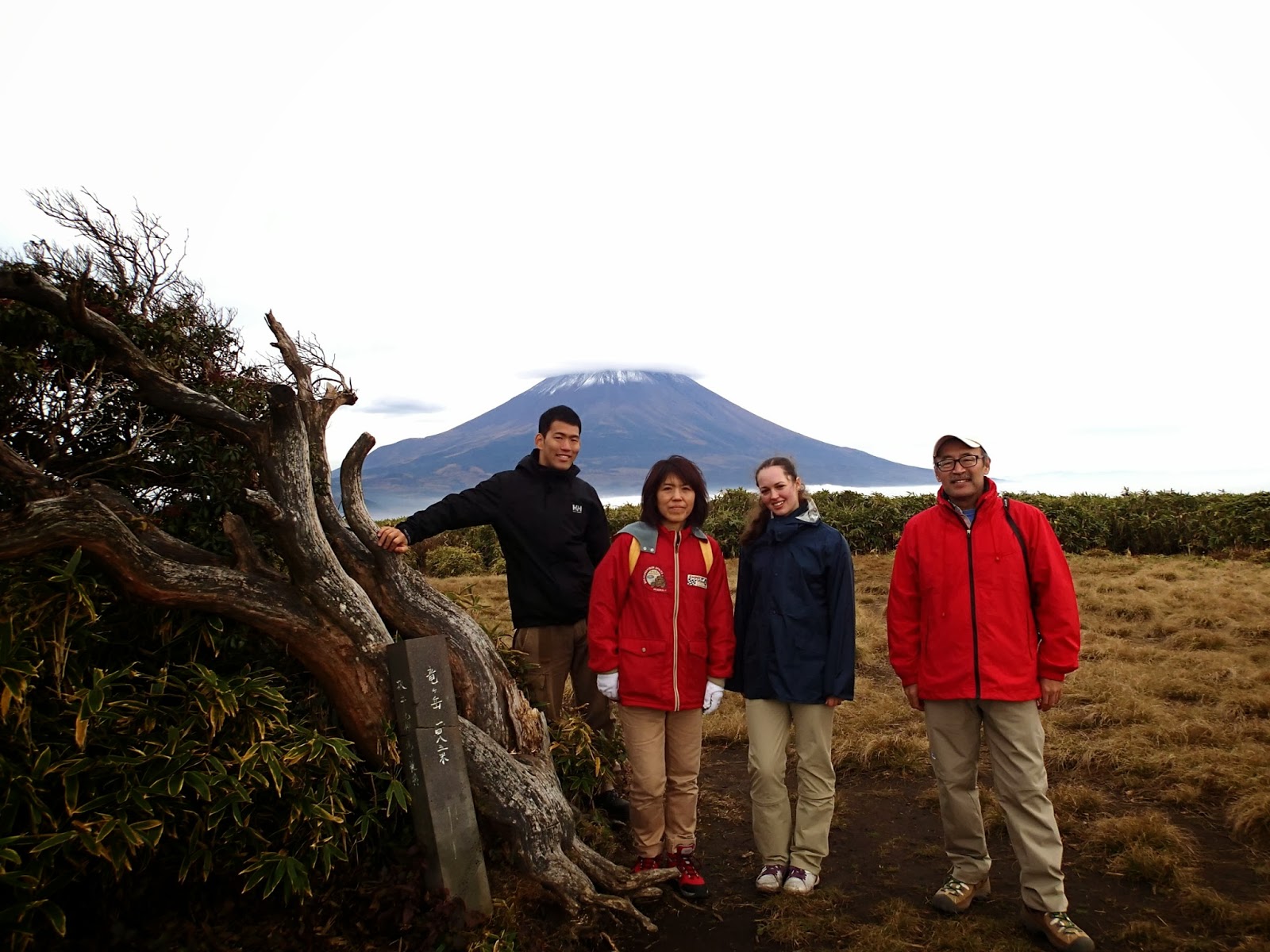
Last weekend I went on a trip to the lake area around Mt. Fuji along with my BF Yuma and his parents for a two-day hiking/onsen/tourist-trip. Our first goal was to climb some of the small mountains surrounding Mt. Fuji in order to get a good view of the mountain. The area around Mt. Fuji is quite mountainous, and there are many routes to choose from. We had first planned to climb Ryugatake (龍ヶ岳), and we started out by the camping area by lake Motosuko (本栖湖) on the west side of the famous volcano. It is easy to find the track from there, and once you get to the sign that marks the entrance to the mountain trail you can follow the path all the way to the top.

Be aware of bears at Mt. Ryuugatake
Mt. Fuji seen from Mt. Ryuugaktake 
At the summit of Mt. Ryuugatake
 Apparently there are some legends behind the name Ryuugatake (Dragon Mountain) too. They all are quite similar, and build around the story that a dragon protected a village from Mt. Fuji's lava during an eruption. For more information about hiking Ryuugatake, see this page (Japanese only).
集合写真
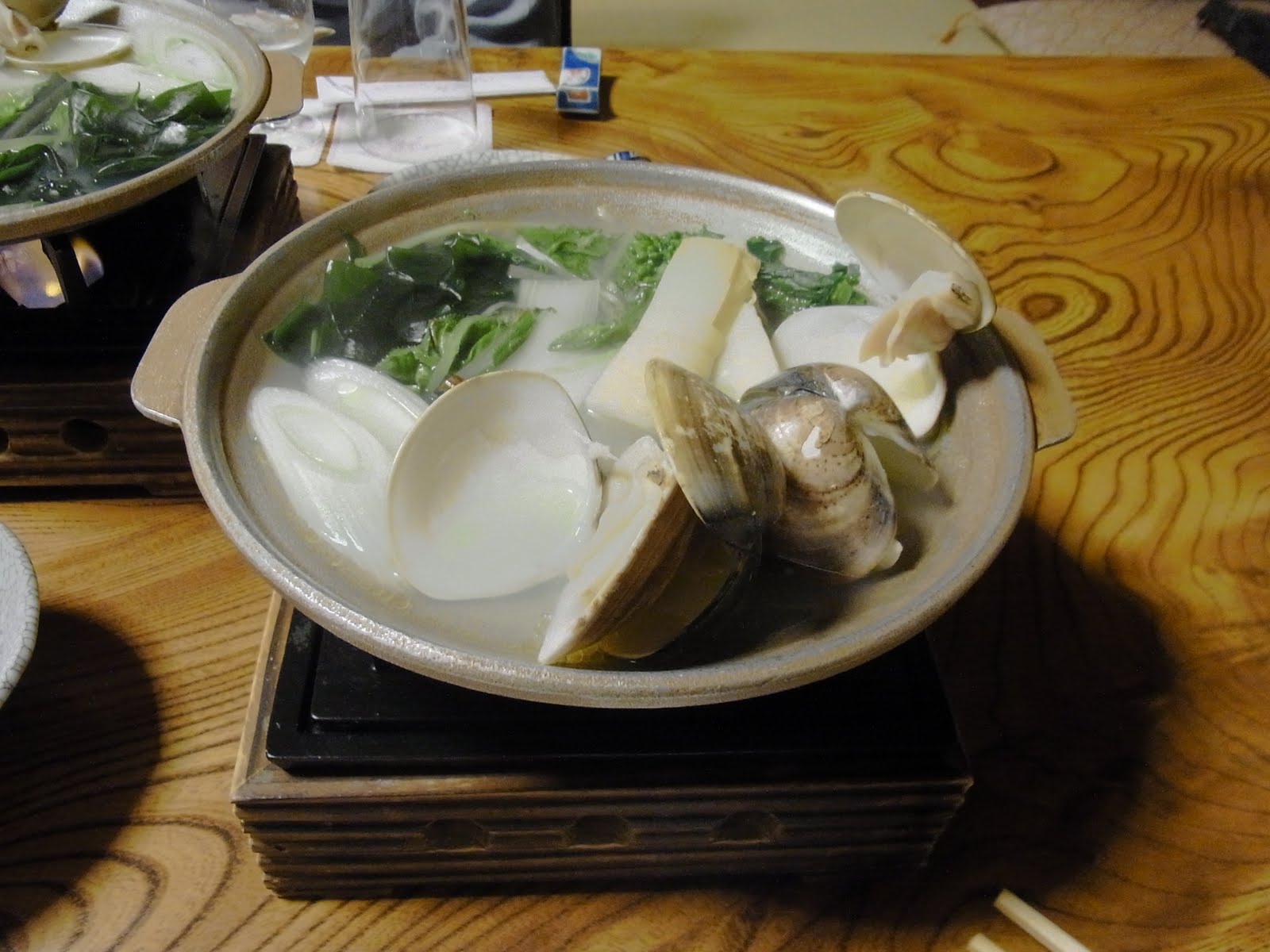
After our day in the mountain we spent the evening at a traditional Japanese hotel (Ryokan) called Fuji Ginkei, situated by lake Kawaguchi (河口湖) with a nice view of Mt. Fuji. At the ryokan we were met with the utmost service, and after having gazed at Mt. Fuji from the hotel's outdoor hot bath (Rotenburo 露天風呂) it was time for Japanese style dinner. Traditional Japanese washoku (和食) food is another expected Japanese contribution to the World Heritage List, and unless you either can't stand raw fish or are generally skeptical to unusual food you're guaranteed to get a lot of satisfaction out of a full course washoku dinner. The staff really pay attention to the details, and every plate we got served looked like some sort of art.

The devil is in the detail.
Dinner time!
The view from our room. Unfortunately Mt. Fuji was all covered by clouds..
 The next day it was quite cloudy so we could not get a proper view of Mt. Fuji from the hotel.. I've added this picture from Fuji Ginkei's homepage, depicting their outdoor onsen and Mt. Fuji:
Mt Fuji seen from Fuji Ginkei's outdoor onsen
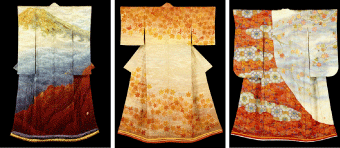
There are several interesting places to visit in the area as well. We visited the Ichiku Kubota Art Museum, where in addition to exquisite kimonos you can enjoy the beautiful garden and various treasures collected by the artist himself from all around the world. Ichiku Kuboto became famous after having rediscovered the Tsujigahana dying technique that had been lost since the 17th century. His museum featured a large number of kimonos he has made through his life, but unfortunately visitors are not allowed to take photographs inside the museum. I've only snapped a couple of pictures of the garden.
The entrance to Ichiku Kubota Art Museum
A red tree seen from the museum's gate. 
In the back of the museum there is a cafe where you can enjoy the view of the beautiful garden
A door inside the garden leading to.. 
Some of Ichiku Kubota's kimonos (take from the museums web page)
Another place that might be interesting to stop by for a short visit, is the small shrine called Tainai-jinja (胎内神社). From the outside it doesn't look like there is anything special about it, but when you enter you find that there is a hidden grotto in the back of the shrine's main building. The name Tainai actually means "interior of womb"... 
Although Tainai jinja looks like an ordinary shrine, that is not totally the case..
A hidden pathway in the back of the shrine
A statue inside the "womb" grotto
Be prepared to have minimal space to move..
No place to be if you have claustrophobia..
 I wouldn't recommend this place if you are afraid of being stuck underground.. But if you can cope with it, then this might be quite a unique experience to add to your list of adventures. It is not a very famous place, so there is not that information available. Place and description can however be found here.
My last picture from the trip. Mt. Fuji and the pretty red leaves..
All in all Mt. Fuji makes a great travel destination even if you don't intend to climb it. There are many places to visit in the area, and I personally think seeing Mt. Fuji from afar in itself is a must for anyone visiting Japan.

I would also like to add that I had a fantastic weekend with Yuma and his parents, and I'm lucky that I have such wonderful people in my life. Hopefully we'll get to spend some quality time together again in the near future.

Related blog posts


Recommended Hotels close to Mt. Fuji

Hotel Kaneyamaen
Hotel Kaneyamaen
Fuji Royal Hotel Kawaguchiko
Kawaguchiko Country Cottage Ban


This page contains affiliate links, and if you follow a link and make a hotel reservation through these links you help support this blog without any additional cost to you. Thank you so much for your kind support!


Thursday, August 16, 2012

Sightseeing in Japan: Climbing Mt. Fuji!

8:47:00 PM

Climbing Mt. Fuji was one of the things that had always been high on my list, simply because it is the biggest mountain (or in reality, vulcano,) in Japan, and the role it plays in the country. Mount Fuji is regarded a sacred mountain for the Japanese, and it has been depicted a vaste number of times, for instance through famous ukiyo-e (浮世絵) pictures.

Wednesday, March 2, 2011

Roundtrip in Japan: Hakone & Mikawaya Ryokan

11:00:00 AM
Arriving in Hakone in the afternoon me and my family wanted to check out the Hakone Komagatake Ropeway, close to Lake Ashi.
We took the bus from the station Odawara, a little distance from Hakone, and since the tourist brochure told us that the ropeway was open all year from 9:10 till 16:50 we hurried over there to be certain we would make it.
But when we came to Hakone-en at a couple of minutes past 16, the ropeway was already closed for the day...In the end, this turned out to be a pricy and bitter experience; we ended up paying over 1000 yen per person by the bus just for this somewhat pointless round-trip to the lake.
Not to mention that we never got the chance to actually take the ropeway.
Hakone has another ropeway too (just called Hakone Ropeway), I guess this one might be more reliable..

Because of this ropeway-failure our mood was kind of down when we finally arrived at the traditional Japanese hotel (ryokan) where we were going to spend the night.
The bad mood did not last long though, cause upon arrival at the ryokan we was welcomed by what seemed to be most of the staff working there; they all came out to welcome us.
I had called them from the information center at Hakone-en to ask for directions, so they were already expecting us. We then received some information about the hotel and a little roundtrip too (the explanation was in Japanese because I preferred that, but the lady showing us around was fluent in English so it shouldn´t be a problem communicating for those without Japanese knowledge).
The ryokan itself was truly interesting; the architecture and the atmosphere was amazing, and the view from the hotel windows was really good as well.

Mikawaya was actually built over 120 years ago.
View from the window in our room. The trees outside are cherry trees, so I guess it must be really pretty with the sakura flowers in the springtime.

Dinner time!

Dinner was included in the hotel prize as well. Here is a picture of the sashimi we got.
Japanese style dinner!
The food was really delicious too. I can't imagine how much this meal would have cost at a normal Japanese restaurant.

We really got a lot of food.

.. Not to mention that we got dessert as well!

After dinner, our dining room was made into a bedroom.
And before getting to bed it was time to check out the onsen-baths!

My brother must have been quite tired after the long day, cause he fell asleep with his yukata still on.. Haha:)

For breakfast, we had the chance to choose between western and Japanese breakfast! Which was great, since I and my brother preferred the Japanese food and my grandmother and great-aunt longed for toast and jam. :p

Western-style breakfast (toast also included)

Breakfast with both western (on the left) and Japanese (on the right) food.

Time for a morning bath!

An old poster of Mikawaya.
Mikawaya ryokan also has some outside baths. If you for some reason don´t like to bath in public they also have some rooms with private onsen-pools though..!
But when we went there it didn´t seem to be that many people there, so most of the time I was the only one using the baths anyway! February probably isn´t the busiest time of the year, but I can imagine it will be crowded in April!!

The outside bathtub

Japanese Bathing Etiquette
If you´ve ever wondered how to take a Japanese bath properly you can check out this poster;)

In March it is time for the Japanese Doll Festival (Hinamatsuri 雛祭り), and at the ryokan they had already finished the preparations.

The entrance to Mikawaya Ryokan
Experiencing this Japanese ryokan was great, and probably one of my best experiences in Japan as a tourist so far. I have no doubt about recommending this place whatsoever.


From Hakone, we returned to Odawara Station, where we took the Shinkansen (bullet train) to Osaka.
Above: Mt. Fuji as seen from the Shinkansen train

Related blog posts


Recommended Hotels close to Mt. Fuji

Hotel Kaneyamaen
Hotel Kaneyamaen
Fuji Royal Hotel Kawaguchiko
Kawaguchiko Country Cottage Ban


This page contains affiliate links, and if you follow a link and make a hotel reservation through these links you help support this blog without any additional cost to you. Thank you so much for your kind support!


About Me

Adventures ofAnette


A modern day shield-maiden who loves to explore the unbeaten paths of the world. From her base in Tokyo, Anette takes on both rural and urban challenges, and goes by the motto "No challenge too big, no adventure too small"!
・Read more →


Recent Posts

recentposts

Random Posts

randomposts