Adventures of Anette

Tuesday, October 25, 2011

Jidai matsuri - 時代祭 - The Festival of Ages

5:41:00 PM
This Saturday was supposed to be the day for the famous Jidai Matsuri (時代祭り), which annually takes place in Kyoto on the 22. October. However, this year was an exception; because of the bad weather conditions it was prospered to Sunday the 23rd.. Apparently the cleaning-prosses of the traditional clothing is quite expensive if the costumes happen to get wet, so no wonder they decided to postpone it.
Jidai Matsuri at Heian Jingu
So for those of you who haven't heard of Jidai Matsuri before I can tell you that it is, along with Aoi Matsuri and Gion Matsuri, actually one of the largest festivals in the city.
The parade itself is a display of various traditional Japanese costumes, from 794 when Kyoto became the Japanese capital, ending in 1868 with the Heian period after which the capital was moved to Tokyo (formerly know as Edo - 江戸). The festival is a celebration of Kyoto's many years as Japan's capital, and one can say that this also is why it is called Jidai Matsuri, or the Festival of Ages.
A lady dressed up like the famous authoress Murasaki Shikibu
The parade starts in the morning at the old Imperial Palace (Gosho 御所), and ends up at the Otenmon-gate at Heian Jingu shrine (平安神宮) more or less two hours later. Did you know that both Jidai Matsuri and Heian Jingu actually dates back to 1895? This is because Heian Jingu was built for the first Jidai festival, in honor of Emperor Kanmu.
I went to the Heian Jingu-shrine, which mentioned is the place where the parade ends, to watch the parade on Sunday. Here I met up with my friend Isabel, her husband and their friend Laura.
Since we were at Heian Jingu already at more or less 12:30 we were lucky, and could pick out some seats with a good view. The parade itself started at 12:00, but it took nearly two hours untill the parade ended up at Heian Jingu. It is still a good thing to be early though, cause trust me, at festivals like this it is essential to be in time; it will definitely get crowded..
Anyway, here are some of my pictures from the day:

Some fancy nobles
Apparently there are somewhere between 2000 and 3000 participants in the Jidai Matsuri..
...and there are definitely a lot of people in the audience as well..
Laura and Isabel :)
You can see all sorts of traditional clothing - and fancy hats - at Jidai Matsuri... :p
One of the Heian - ladies
Right in front of the Heian jingu shrine there was also held some performances during the festival
A mikoshi being carried through the gates of Heian Jingu

Related blogposts


Thanks for reading! Feel free to leave me a comment or question below!
~Anette

Tuesday, October 18, 2011

Life in a Japanese village: Benten-san Matsuri 弁天さん祭り

1:17:00 PM
The great thing about living in a Japanese village is that you get to participate in a lot of activities that you wouldn't have the chance to if you lived in a big city. The reason for this is that my community really likes foreigners, and they let me participate in all their local activities. I guess foreigners are more rare when you get just a little bit outside the bigger cities (I actually live only a 30 minutes bike ride from Kyoto, so its really not that far)
Last weekend I joined my neighbors for the local sports day (運動会), and this weekend I got to participate in their Benten-san festival.
This festival is for the Japanese goddess Benten (more commonly known as Benzaiten), who is considered one of the seven Japanese Gods of Fortune.

Drummers in front of the local shrine
Preparation by the local Buddhist priest
After a meeting with other people from the community at the local shrine we took of with our  mikoshis, one for the men, one for the women and some smaller ones for the kids to carry. 
So what we did was basically carrying the mikoshi to different parts of the neighborhood, and when we got to a new area, we stopped and took a break. We were welcomed by the people there, and while the drummers were playing and some of the men danced around in dragon costumes we received food, drinks and snack from them.
The men carrying the otoko-mikoshi (男神輿)
The women's onna-mikoshi 女神輿
Me carrying the mikoshi
 We also stopped by a couple of senior citizens' homes, and it seemed like the inhabitants thought it was nice with a little festival too.
A dragon entertaining an old lady at the senior citizens' home
 I think we might have stopped by more than 10 different places during the day, and at all the different places we received warm welcomes from the people living there. Trust me, when the day was done I'm pretty sure i had gained some kilos.. I ate and drank way too much, haha..
Lunch break! For the 4th or 5th time that day.. :p
 Also, we was really lucky with the weather! Both Friday and Sunday had been terrible, with rain poring down like in my hometown Bergen.. And actually it was supposed to rain on Sunday as well, but I guess we had good luck on our side. The weather was instead almost too hot, haha :)
Anyway, it was a really great day! I wish they had these types of festival more often.. I had so much fun! Not to mention that it is not often that foreigners get the chance to participate in festivals like that, so it was also kind of a unique experience. The people in the neighborhood was so welcoming, and some even invited me to come visiting them whenever I want.
Conclusion: Haradani might be situated in the middle of nowhere, but you can still have some nice experiences here:) Haha..

So, some final pictures from the matsuri:
The mikoshi from a closer angle
Apparently it brings good luck to stick your head into the dragons mouth..!
祭, the Japanese sign for Festival.
My neighbors serving us Japanese food such as yakitori.
Some more drummers
Again, the onna-mikoshi
Finally back at the shrine after nearly 7 hours of walking (, eating and drinking;p)
Some final rituals before the matsuri is over.
Peace out!

Monday, October 10, 2011

Student Life in Kyoto: My Japanese Sports Day (運動会)

5:58:00 PM
This Sunday my landlord gave me the opportunity to participate in the local sports day, or undōkai (運動会) as it is called in Japanese.
Since today, Monday the 2nd of October, is a national holiday dedicated to sports, there are usually a lot of sports days taking place all over Japan in the weekends before and after this date.
The sports day I participated in was situated not that far from the little valley I live in, which situated north of the famous temple Kinkaku-ji (金閣寺), better known as The Golden Pavilion.
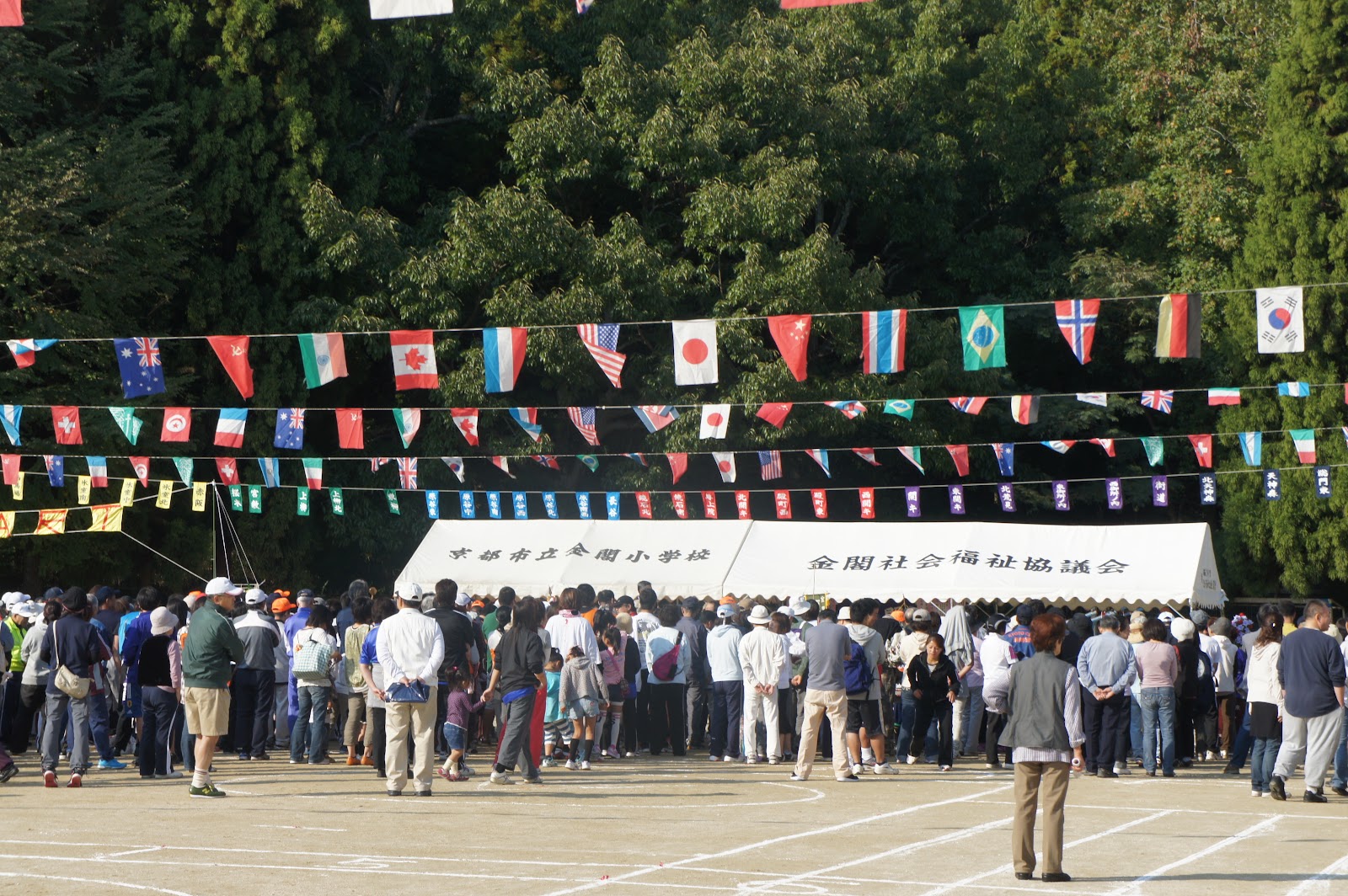
People from the whole ward was participating in the sports day (Named after the place, the arrangement was called 金閣学区民体育祭), and I competed alongside with my neighbors in Haradani (原谷), the place where I live.
This was actually my first time to participate in a sports day in Japan, and I think it was quite exciting! I got to meet all my neighbors, and to compete against people from my community in a wide range of activities.
Haradani Hokubu

People gathered for the opening speach
Most of the competitions involved a bit of running, which suited me just fine. And since the competitors received some prizes depending on their results in the competitions, I actually got a lot of Japanese food to take with me home afterward as well. Lucky!
The age of the participants varied a lot, but I guess there was most kids or people over thirty. So I guess I had an advantage there.
The only time things didn`t go so well, was in the competition where we had to run and pick up a random paper board with a word for an object written on it, and then had to find a person carrying that object. Lucky me got a sign where it said 30 000 yen.. I mean, almost nobody goes around with that amount on them, that's close to 400 dollars.. So, I have to admit I lost badly on this one.
But still, I had a lot of fun. It's all about participating, right?! ;)
One of the running contests
The sports day`s brochure
Lunch break
The obentou we got for lunch was really delicious!

Members from Haradani Hokubu
After the undōkai we had an afterparty with the rest of the neighborhood where we had delicious Japanese food, and since there was still good left when the party was over we even got the chance to take some with us home. So now I will have great Japanese food for lunch for a couple of days:D I certainly wish there was more undōkais coming up:p
Tug of war
The kids are running for candy!
Ball-throwing contest!

Wednesday, October 5, 2011

Back in Japan: Studying International Relations @ Ritsumeikan Graduate School

6:48:00 PM
Hi everyone, here comes a short update from Japan..!
After having spent my holiday in Bolivia working as a volunteer, taking classes in Spanish and not to mention traveling around the country I'm now back in Japan ready for a new semester.
That is to say, I am no longer an exchange student at Ritsumeikan University like I was before, instead I'm a full time student enrolled in their master degree program for International Relations, more specifically the Global Cooperation Program.
The characteristic clock tower at Kinugasa
But besides the master degree in International Relations Ritsumeikan also offers a so-called DMDP (Dual Master Degree Program), which means that you have the opportunity to go abroad to one of their Partner Universities and take a master degree there as well. If you work hard enough that means you have the opportunity to take 2 master degrees in 2 years.
And even though I haven't 100% made up my mind if I'm going through with it or not I am taking a lot of credits this semester to ensure that if I decide to take the double degree I'll have enough credits to finish my master at Ritsu in a year.
Normally you need 30 credits to finish your 2-year long Master Program at Ritsumeikan, and this semester I'm taking 21. This way I will have more time to write my thesis next semester!
So far it is going good, but that might be because we haven't started to get a serious load of homework in a lot of the classes yet. I will definitely be busy once we get started for real..!
But still, I think this semester will be nice. I also finally got the chance to take classes in other languages than Japanese, so this semester I'm taking a Spanish and a German Reading & Discussion class. Which has been going well so far.!

Banners at my campus (Kinugasa)
Also, since I came back I got myself a new apartment; I now live in a little village in the forest north of Kinkakuji. It is a nice place, and they are arranging some activities in the local community that I get to participate in as well, such as an 運動会 (local sports day, actually this weekend) and a festival (祭り).
I guess Ill be writing another blog post about my apartment and so on later, cause both the apartment in itself and also the village is really nice. Only thing is that I don't have internett in the apartment yet..  But still it is not that bad, because it makes procrastinating a bit harder! Haha..

Anyway, I am heading to the gym in some 10-15 minutes, so I better get going. Hasta luego!

Sunday, September 25, 2011

Sightseeing in Bolivia: Salar de Uyuni

6:52:00 PM
Last weekend me and Lotte went to the Salar de Uyuni, which is Bolivia's best know tourist destination and also the biggest salt flat in the world.
From La Paz we took the 21:00 night bus to Uyuni. It was not exactly cheap; we payed 230 Bol for one way, but it was the only alternative we had. The reason for that is that it was a tourist bus, the local busses costs between 80-155 Bol and they had already left the terminal at 19:00.
The good thing about the tourist bus though, is that you get some meals on the way; you both get dinner, breakfast and a bottle of water for later.
But if you want to take the night bus you should be aware that no matter which company you go with you'll have to prepare for bad roads! The first part of the way is quite alright, but for the last 4-or-so hours there was no pavement so it was extremely difficult to get any sleep at all.

The buss arrived in Uyuni a little later than sceduled, which normally is 7 am. But still, it was more then enough time to check out the place, and the first thing we did was to go looking for a travel agency who could take us on the trip to the Salar.
It is not hard to find a travel agency, because they'll be there waiting outside the bus in the morning and contact you on the street to try and sell you their tickets. The problem is that not all of them can be trusted, and you might end up in a rusty old car that should have been trashed a long time ago.
Therefor it might be a good idea to do a little bit of research before you go there, so at least you have some alternative companies to choose from, or just to know which ones you should avoid.
The train cemetery
In the end we ended up with a company that was called Andrea Tours, and we payed 450 Bol for a two-day trip.
So together with 4 other tourists from South-Korea, Germany and Spain and a local Bolivian guide we headed of towards the desert. The first stop we came to was the so-called train graveyard, where you can look at old steam locomotives, or if you prefer it you could always climb on them as well.. Anyway, it isn't really a pretty sight since the trains are covered in graffiti. Not that it would have been that much more fantastic if there weren't any graffiti, but still..

Me and Lotte climbed up one of the trains
After the short stop we finally were going to see the salt flat itself. And the view didn't disappoint, it is really beautiful with the landscape, the air is so fresh (especially when you are used to the smelly air in La Paz) and not to mention that it is really peaceful as well.
I have to say though, that I thought it would be more fantastic than it was. I mean, if it weren't for the salty taste it might as well have been snow. And we do have quite a lot of snow in Norway, my home country.. So actually, rather than Salar de Uyuni I would recommend a trip to Svalbard instead, if you can handle the cold.
Anyway, for some reason I just think that the salt flat looked more like a lake covered with ice. A couple of times I found myself thinking that "I hope the ice can hold this van" while we were driving through what looked like a winter landscape.
The landscape actually made me think that we were walking on ice - not salt..
A pile of salt
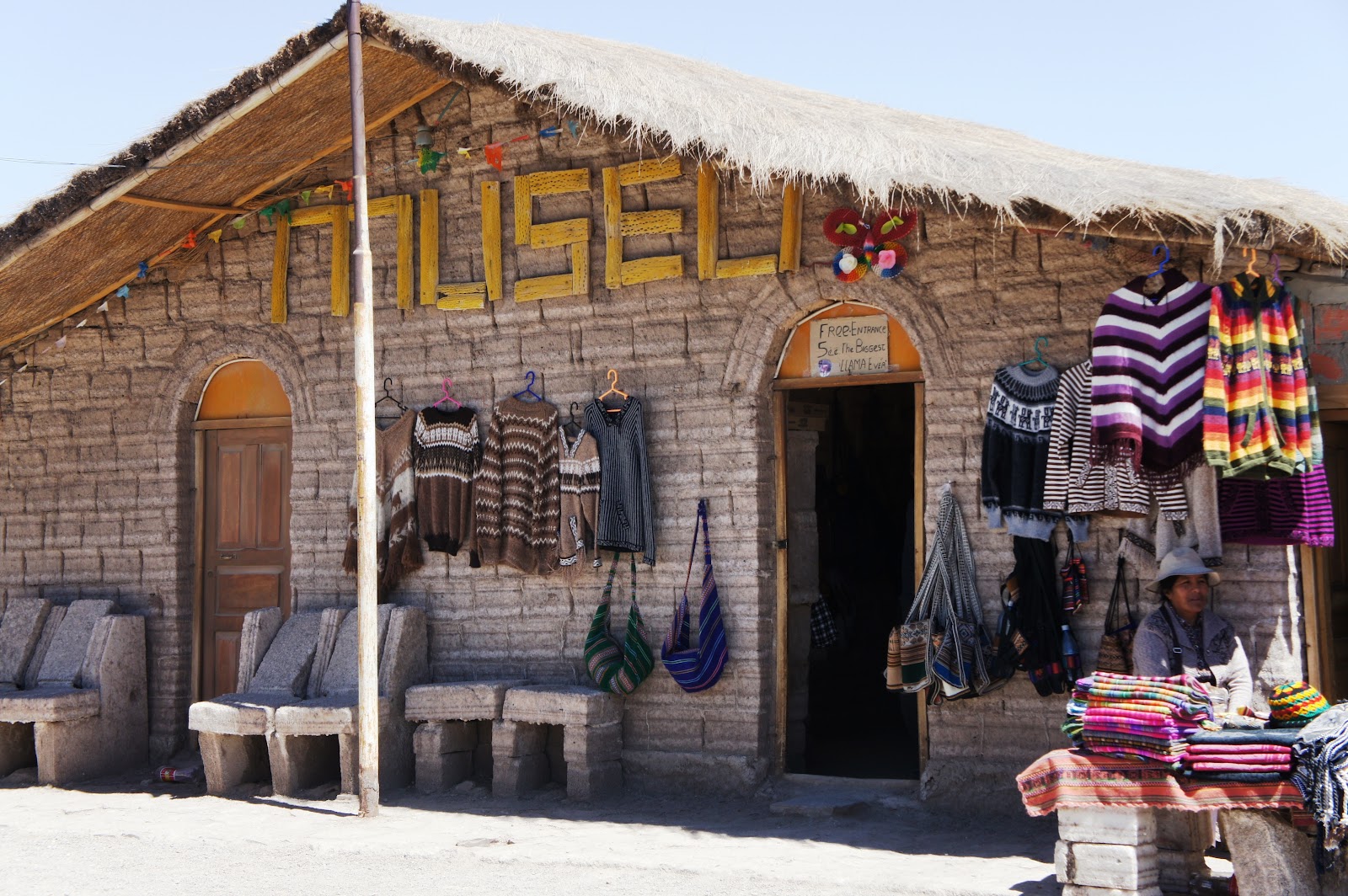
After some quick photos on the ice - I mean salt - we went to a tiny tourist where they were selling souvenirs - if you're looking for sweaters and accessories made from alpaca wool, items made of salt etc then you can find it here. And the stuff made of salt is really cheap, because there is so much raw material to take from.
Our next stop: a tourist market..!
On the market you can buy nice gifts made of salt, and they only cost around 10-15 Bol..!
Beside the market there is also a museum here, where you can take a look at some sculptures made of salt. It doesn't anything to go in and take a look, but they do have a souvenir shop there as well so it is possible to support the museum by buying something there instead.
There is also a tiny museum there, where they have some statues made of salt.
A salt llama, along with some items that are for sale
Lotte and a clock tower, also this one made of salt.
After the stop at the market it was time to travel further out into the desert. We stopped in a place in the middle of nowhere to have lunch and to take some more pictures. There was only one building here, and that was a hotel made of salt.
A salt hotel to the left.
Of course we had to take some silly pictures too :p
And make some salt-angles(..?)
After a while it was time for lunch, and it was llama-meat with quinua and vegetables. It was really good! Afterwards the guide told us that we were going to have a 30 minutes break before we continued the trip. We had kind of already taken the pictures we wanted, but decided to spend some minutes relaxing in the sun. The only thing was that the guide didn't return after 30 minutes, I guess we must have waited nearly an hour when he finally decided to show up again..
All the cars lined up. To the right there are some salt tables where we ate lunch.
After the guide finally had returned we continued our trip through the flats, and stopped at the island Incahuasi, which is more known under the name Isla del Pescado because it apparently is shaped like a fish. On this island you have the opportunity to pay 30 Bol to climb the island. The guide gave us an hour to check it out, but me and Lotte decided that we would rather go around it than climbing it.
Which actually turned out to be quite a good idea!
On our way around the island we did see a lot of huge cactuses, and not to  mention we also got to see a special type of rabbit which goes under the name viscacha.
A house and some cactuses at Incahuasi Island
Me and a pretty huge cactus we passed by
Strange formations in the salt
The others told us that the trip up to the island hadn't been all too impressive, so I'm quite glad that we decided to walk around it instead. It took us about 45-50 minutes, so the timing was perfect.!

After Incahuasi we were supposed to travel to our hotel in the village close to the volcano Uturuncu, but for some reason the hotel was full, according to our guide, and we had to go to another hotel quite far from where we were supposed to be.
Inside our salt hotel room
Evening view from the salt hotel
Fair enough, at least this hotel also was made of salt.
But when it was time for dinner it turned out that our hosts at the hotel didn't have any food for us since we came on such a short notice. First we had to wait for two hours watching the other groups getting their delicious-looking food, and then when it finally was our turn to get food then all we got was a plate of spaghetti. I guess all of us went to bed a little bit hungry that evening.

The second day of our trip we had a quick breakfast, and then it was off again. But when we were about to leave the guide asked us if it was fine that we brought with us a girl that was going to town. We said that it was alright, of course, but then it turned out not only to be a lady, but also her 5-6 year old kid. Suddenly me and Lotte didn't have any space anymore; the lady wouldn't take the kid on her lap so the four of us sat quite squeezed together in the back seat.

The village by the foot of the volcano
We drove back passed the island we had visited the day before, and to the root of the volcano where there was a little village. Here we once again had to pay a small fee, this time to be able to visit the volcano. By the volcano there was also a cave where they had some old mummies, apparently they were supposed to be 500 years old or something but I'm not quite certain if that is true..

The entrance to the cave of the mummies
A couple of the mummies from the cave
After the short trip to the cave we had the opportunity to climb up to the volcano. Unfortunately we didn't have the time to go all the way to the top of the volcano though, but it was quite alright anyway.
View towards the volcano
On our way down we passed by a lot of llamas too.! They are so cute.. Haha..
A curious llama
Back down again we had our last lunch, and finally we got some good food unlike the dinner we had the day before.
Time for a group picture!
Before going back to Uyuni the last thing we got to see were some flamingos..!
We arrived in Uyuni at 4 o'clock, so we decided to buy some souvenirs and have dinner before our bus to La Paz was leaving. We soon discovered that the souvenirs in Uyuni actually are cheaper than in La Paz (or perhaps we just were lucky with the shops we visited), and the people working in the small shops we went to in the street next to the bus station were both polite and helpful so we did buy quite a lot of souvenirs here.

The bus back to La Paz left at 8 o'clock, and this time we went with a local company and the ticket only costed us 80 Bol each. The only problem was that the bus weren't direct, which nobody really told us.. The bus stopped in a small town a couple of hours from La Paz, and most of the bolivians left the bus. I was half asleep when the driver came to us and told us that "se ceda en dos horas". So we presumed that the bus was going to leave for La Paz in two hours, which it never did. The bus driver was just sleeping, and after the two hours had passed I waked him up and asked when he was going to take us to La Paz. But he said he wasn't going to La Paz after all.
In the end he followed us to the bus station and found us another bus for La Paz. He did pay our ticket, but it was still a bit annoying that nobody had bothered to tell us that the first bus weren't going to La Paz when it was clearly written La Paz on the bus and everything..
People in El Alto busy with their blockade
And our problems weren't over: When we arrived in El Alto around half past 7 in the morning there was another strike going on, and the roads were blocked. Typical Bolivia. The driver couldn't get any further, so we had to walk from the outskirts of El Alto to get to a place where it was possible to find some transport.
I don't think I'd ever knew that El Alto actually was this big if I hadn't tried to walk through it.. It took forever (and it didn't really help that we already were quite tired after an unpleasantly bumpy trip with the night bus)
We had walked for more than 2 hours when we passed the last part of the blockade and finally could find a bus to take us down to La Paz.

Though it would have been nicer if we had avoided all the trouble on the way I must say that all in all we did have a really great trip to Salar de Uyuni. It was a very special trip, which I'm pretty sure won't be forgotten anytime soon..


Related blogposts


Bolivia Death Road!
Sightseeing in Bolivia: Cycling The Death Road
The Choro Trek
The Choro Trek 1: La Cumbre to Sandillani
la paz
Bolivia's National Day and Sightseeing in La Paz

About Me

Adventures ofAnette


A modern day shield-maiden who loves to explore the unbeaten paths of the world. From her base in Tokyo, Anette takes on both rural and urban challenges, and goes by the motto "No challenge too big, no adventure too small"!
・Read more →


Recent Posts

recentposts

Random Posts

randomposts