Adventures of Anette

Tuesday, December 15, 2015

Trendy Tokyo Accommodations: Sake & Culture at Asakusa's Bunka Hostel (ブンカ ホステル東京)

10:31:00 PM

In the heart of Asakusa lies one of Tokyo's most stylish hostels called Bunka Hostel Tokyo. It is situated in a building that used to be a pachinko parlor, and the whole building has been renovated for the convenience of foreign travelers. The name of the hostel comes from the Japanese word Bunka (文化), or culture, and when you're inside the building you can feel the cultural mix between Japanese tradition and modernity. In addition to offering 128 beds for travelers looking for reasonable accommodation at a good location the property also has all the amenities and facilities needed to enjoy a comfortable stay in Tokyo included free 24-hour front desk, multilingual staff, and free WiFi.
Entrance decorated with flowers
I went to Bunka Hostel for their grand opening reception on December 14th along with a couple of colleagues, and we were met by excited and friendly staff who were doing their utmost to ensure a successful reception. The lounge area was filled with guests; It had apparently been quite easy to attract people to come thanks to the property's exquisite style and convenient location, and we could meet a lot of interesting people in addition to the hostel's staff.

The reception desk with shelves symbolising Mt. Fuji in the background
The whole first floor is used as a cafe/Japanese style Izakaya, so guests can enjoy a drink or two here in the company of other travellers. You can actually enjoy your day/evening at the bar/cafe regardless of wether you spend the night here or not, but access to the guest floors is limited to guests only (see further down the page for information about rooms).
A globe at the reception desk
One of the main themes of the hostel is Japanese rice wine, sake, and Bunka Hostel has their own special variety of sake prepared for its guests. The taste is not that sharp, so it is especially a great chance for foreigners who haven't tried sake before because of its milde aftertaste. Instead of glasses we were given a square wooden box called masu (枡; see picture below) with sake in it, and the smell of wood added an extra dimension to the drink.

A pyramid of masu
One-cup Bunka Hostel sake & masu
Throughout the year there will also be a range of entertainment and activities prepared for Bunka Hostel's lucky visitors, such as for instance an event for making rice cake called mochitsuki (餅つき), and perhaps also activities the guests can participate in such as flower arrangement (生花, ikebana). There were also various forms of entertainment and performances at the opening reception, and the picture below shows some of the performance artists who are dancing around in the lounge. They also held a performance in the guest room area, which I've written more about below.
Performers wearing Japanese masks and dancing a sake dance
In addition to the more abstract entertainment there were also official speeches by the hotel's executives, and the traditional ceremony event Kagami Biraki (鏡開き). This word means "Opening the Mirror" and refers to the opening of a cask of Sake which often is a standard element at the opening day of Japanese companies. You can see a short video of the Kagami Biraki ceremony below.
Speech
Sake barrel used in the Kagami Biraki ceremony

Bunka Hostel has seven floors with both a female only floor, mixed floor and one exclusive family room. If you are fine with little space then the bunk bedrooms will provide you with the privacy you need to get a good rest in between all the sightseeing and fun in Tokyo.

Bunk beds
The 4th floor guest floors
One of the beds
For the opening at Bunka Hostel the guest floor was used as a base for abstract art by the performers, and they managed to enhance the charm of the different rooms through their creative displays. As you can see from the photos below, some of the rooms were occupied by mysterious "guests" where others simply were decorated with traditional Japanese objects.
One of the bunk beds decorated with a Japanese ornament
Performance artist playing with the light
Disco bed
An art performer in one of the rooms wearing a traditional mask
In addition to the guest rooms, there is an available kitchen usable only by the guests staying at Bunka Hostel. The kitchen doesn't have a stove but is equipped with a refrigerator and other necessary amenities such as a microwave oven and a toaster.
Kitchen
Kitchen
From the bathroom area
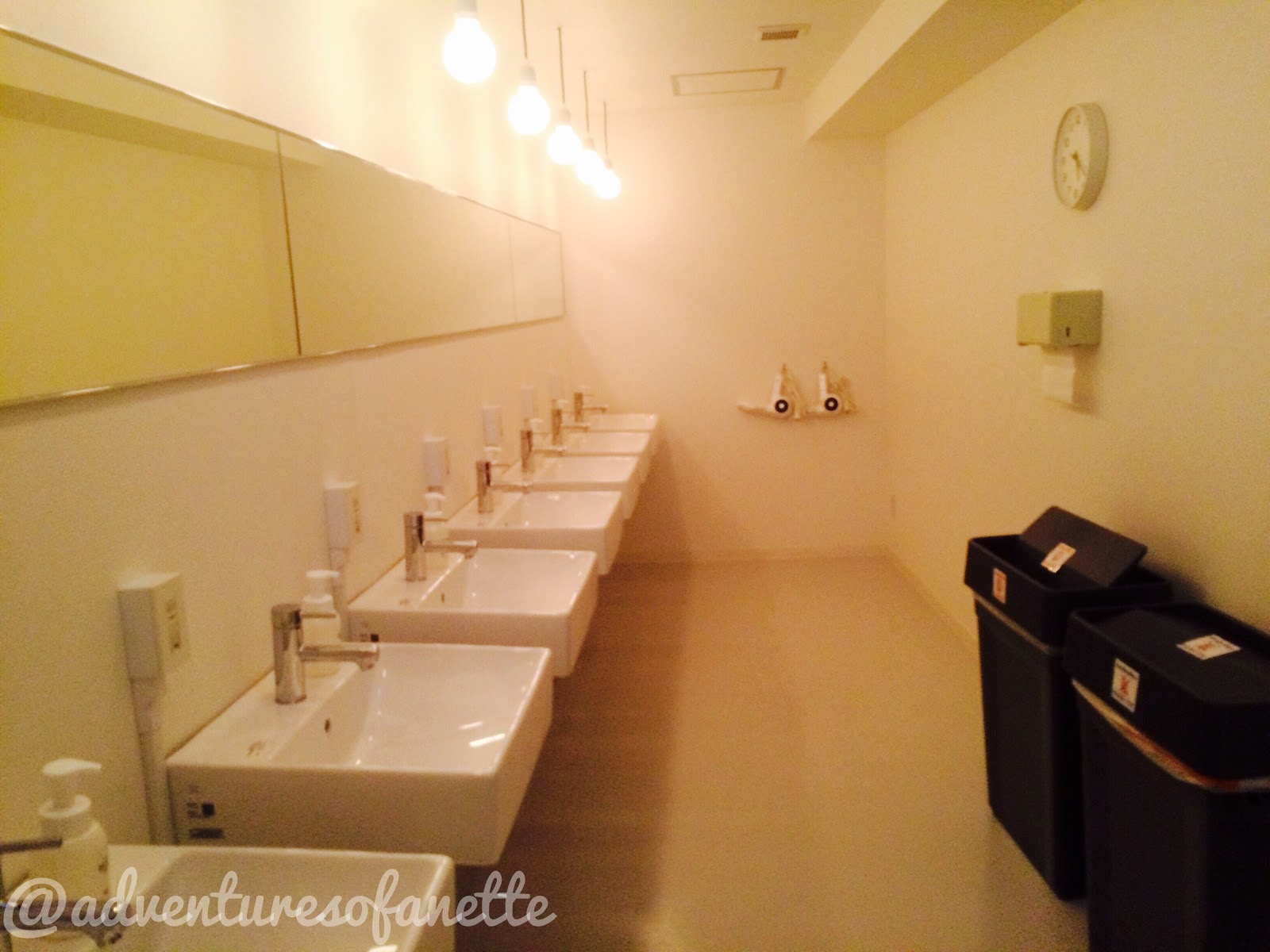
The hostel comes with shared bathroom for the people who stay in the bunk bed section. With a large number of toilet rooms and showers available it is likely that people will be able to use these facilities without having to worry about availability. For those who don't like to share common facilities with other guests it is, however, possible to rent the hostel's one and only exclusive family room where, in addition to more privacy, you'll have a great view of the Sky Tree from your bed.
Sky Tree seen from Bunka Hostel
Bunka Hostel Tokyo's Family Room

Asakusa is located in Taito ward, which is the most popular area in Tokyo for foreign tourists. Using this place as the base for your stay will grant you easy access to many of Tokyo's best tourist spots, including the Kaminari gate (雷門) which is only a couple of minutes away by foot. In the table below are some of the features you can get at Bunka Hostel.
The world-famous Kaminarimon


-----------

This page contains affiliate links, and if you follow a link and make a hotel reservation through these links you help support this blog without any additional cost to you. Thank you so much for the kind support!

-----------

Related blog posts

Monday, December 14, 2015

Happy Wedding: Reusing my Mom's Old Wedding Dress 【ママのウェディングドレスの再利用】

4:41:00 PM

I got a package from my family in Norway. My mom's old wedding dress. It hasn't been worn for more than 26 years, and is discolored with yellow stains here and there. But it's perfect. I'm so honored that I can get married in the same dress as my mom did when she married my dad♥ 


ノルウェーにいる家族からあるパッケージが届いてきた。中にはママが26年ぐらい前に使ったウェディングドレス。シルクサテンが古く、染みがついている。でもこのドレスで完璧。ママとパパが結婚した時にママが着てたドレスで私も結婚できるなんて、光栄だわ〜〜(*^^*)!


Related blogposts

Saturday, December 12, 2015

Sightseeing in Izu: The 400-year old Bora-Naya Restaurant (ぼら納屋)

3:49:00 PM

Bora-Naya restaurant with the original fisherman's hut in the right corner
During my recent trip to Izu we stopped by an old restaurant with an almost 400 year long history called Bora-Naya (ぼら納屋) on our way to visit the Jougasaki coast (城ケ崎海岸). The original Bora-Naya was constructed in 1627 as a fisherman's hut, during a period when bora fishing was extremely popular. 

The entrance to Bora-Naya
Bora fishing in the area continued until 1964, but both the number of young fishermen and bora kept getting fewer and fewer. The historical Bora-Naya has been restored and now serves as a restaurant where it is possible to enjoy fresh fish (their dishes with splendid alfonsino 金目鯛 are especially popular) and shellfish from the coastal waters of Izu. 


Here is some local tourist information about the restaurant:
Bora-Naya was constructed by the Kii family (near the present-day Wakayama) in 1627. Later, several extensions and structural alterations were carried out on the building. The bora (striped mullet) fishing industry operated under the protection of the Tokugawa Shogunate. During the seasonal migration of the bora, the villagers would live here and while repairing their boats and nets, went out fishing with the signal of a trumpet shell or flag.

It has been said that bora caught here were sometimes taken to distant Edo to enliven the dining table of Tokugawa Iemitsu, who was the third generation Tokugawa Shogun.


The restaurant also has a pool right outside the main building, so for guest visiting during the summer it is possible to combine the visit with a refreshing dip in the pool.
From Bora-Naya's homepage

Basic information

Name of Restaurant Bora-Naya (ぼら納屋)
Address 〒413-0231 静岡県伊東市富戸837
837 Futo, Itō-shi, Shizuoka-ken 413-0231
Access ①By bus from Itou Station (伊東駅)
②By foot from Jougasaki-Kaigan Station (城ヶ崎海岸駅)
Business Hours October 21 to March 20: 09:00-16:00
March 21 to October 20: 09:00-17:00 / Closed on Thursdays.
Parking 120 cars(Free parking for 2 hours if you eat at the restaurant)
Homepage http://www.boranaya.com

Related blogposts


Recommended Hotels in Izu

ABBA Resorts Zagyosoh
Nishiizu Koyoi Onsen
Arcana Izu
Arcana Izu
Hotel Izukyu
Hotel Izukyu


This page contains affiliate links, and if you follow a link and make a hotel reservation through these links you help support this blog without any additional cost to you. Thank you so much for your kind support!


Thank you for reading! Please feel free to leave any comments or questions below
Anette

Thursday, December 3, 2015

Sightseing in Izu: The Ryugu Sea Cave (竜宮窟)

11:12:00 PM
Entrance to Ryugu Sea Cave by the roadside
In the southern part of Japan's Izu peninsula you can find white beaches and great places for water activities such as snorkeling and surfing. But there are also interesting areas to visit if you prefer activities where you can keep out of the water, such hiking or cave exploring. On my reason trip to Izu we stopped by some beautiful caves, and among them was the Ryugu Sea Cave. Here is some tourist information about the sea caves in the area provided by Shizuoka Prefecture's Shimoda city.
"Submarine volcanic landforms became uplifted in the process of the collision between the Izu block and Honshu across several million years. The landforms exposed due to upliftment then underwent erosion by wave action, and the weaker sections were washed away quickly. This process created sea caves. Subsequently, as the erosion expanded and the cave grew bigger, the roof partially fell off, creating this large open topped cave. From the watch point above the Ryugu Sea Cave, it can clearly be seen how erosion proceeded in two directions. This appears like the shape of a heart, and you can probably imagine how this sea cave looked like in ancient times before erosion brought it to its current shape. You can also enjoy different appearances of the cave depending on the direction of the sunlight or high and low tides."
On the way into the cave 
Here is more information, also taken from Shimoda city's tourist information:
The structures of Ryugu Sea Cave can be observed through a gaping hole, which is about 40 meters in diameter. At the cliff, the strata of subaqueous fallout ash and volcaniclastic flow are observed.

The waves eroded the weak parts of the strata, and formed the cave that divided into two directions. Eventually the cave ceiling became unstable, and collapsed and this skylight was formed."


From inside the cave it is hard to notice anything special about the formation of the cave, but if you take a walk around the outside of the cave you can find a small path that takes you around to the top of the cave. Perhaps you can see a familiar shape in the picture below? The Ryugu Sea Cave is actually famous for its "heart" shape, and is especially popular among couples.
Ryugu Sea Cave is shaped like a heart if you look at it from above

Right next to the Ryugu Sea Cave there is also a small beach where you can try sand skiing:
"Sandback for skiing: A steep (about 30 degree) sandbank with a width of 100 meters, formed and maintained by upward migration of sand particles because of strong winds. You can enjoy skiing on its slope and may be charmed by the beautiful structures of submarine volcanoes around here.

There is a habitat of crinum lilies along the trail to the sandbank. The plants are designated as a natural monument of Shizuoka Prefecture and you can find their blooms during summer to autumn every year."
Slope for sand skiing 
We visited in late November so it wasn't exactly the best temperature to try out sand skiing. Perhaps next time!

Basic information

Name of Place Ryugu Sea Cave (竜宮窟)
Address 〒415-0029 静岡県下田市田牛
Touji, Shimoda, Shizuoka Prefecture 415-0029
Access By car
Parking 10 cars
Homepage http://www2.shimoda-city.info/shimoda/

Related blogposts


Recommended Hotels in Izu

ABBA Resorts Zagyosoh
Nishiizu Koyoi Onsen
Arcana Izu
Arcana Izu
Hotel Izukyu
Hotel Izukyu


This page contains affiliate links, and if you follow a link and make a hotel reservation through these links you help support this blog without any additional cost to you. Thank you so much for your kind support!

Thank you for reading! Please feel free to leave any comments or questions below
Anette

Sunday, November 29, 2015

Sightseeing in Chiba: Hiking Mt. Nokogiri (鋸山)

9:26:00 PM

Chiba Prefecture is one of the three prefectures surrounding Tokyo, along with Kanagawa (Yokohama) and Saitama. Although Chiba is most known for Narita airport and Disneyland (yes, it is in fact not situated in Tokyo despite the name) the prefecture also has a lot of other things to entertain its visitors such as beautiful beaches, great mountains for hiking and hot spring ryokan. 

Monday, November 23, 2015

Try it yourself: An Oiran (花魁) Cosplay Experience in Japan

6:16:00 AM
Most people have heard about the Japanese escort ladies called geisha, known in the West through for instance the world famous book & movie “Memoirs of a Geisha”.
Throughout history there have however been other types of Japanese escort ladies, and the forerunner to the Japanese geisha is known as oiran 'woman of pleasure'. 
Oiran was a popular profession during the Edo period (1600~1868). Back in the early days of the Edo period the Oiran were considered high class courtesans, and unlike yūjo (遊女) prostitutes they were first and foremost entertainers with refined skills in a number of traditional arts such as sadō (Japanese tea ceremony), shamisen (three-stringed Japanese bajo), ikebana (flower arranging), and calligraphy. Elegant as they were, some Oiran women even went on to become famous outside of their daily workplace, and have inspired various Japanese fashion trends throughout the years.

The word oiran comes from an abbriviation of the sentence "Oira no tokoro no nēsan" (おいらの所の姉さん), which can be translated into "my elder sister". The kanji characters used to express this word are "flower" (花) and to "charge ahead of others" (魁). 

Although Oiran is a tradition of the past that ended with the rise of the geisha and later almost disappeared along with strict laws enforced to stop prostitution there are still people who are working to keep the tradition alive. But a big difference from the past is that today women dress up oiran style in order to preserve a cultural heritage or to entertain rather than having it as a profession or lifestyle, and it does not include sexual services anymore. I've written more about the difference between Oiran and Geisha here.

Even though it no longer is a common profession nor holds the popularity it used to have in the past one can still find extremely popular events and festivals dedicated to oiran, such as for instance the Bunsui Sakura Matsuri Oiran Dōchū that is held every year in Tsubame, Niigata. 

The vivid and colorful style also keeps attracting people who are interested in Japanese fashion and traditional arts in general. As a result of this popularity there are also a growing number of companies out there offering people who are interested the chance to try on the oiran outfit themselves.

La Petit Fleur in Oukurayama
As you've probably noticed from the pictures above I recently had the honor of getting dressed up in a oiran style kimono. This opportunity came through a company called Workshop Japan, who's goal is to help introduce Japanese culture to foreign visitors. In addition to offering oiran cosplay they also hold various other workshops that foreigners can attend, such as Kazari-maki-zushi(Art Sushi Roll) cooking class and Japanese calligraphy.

The Oiran cosplay experience was a cooperation between Workshop Japan, a flower shop & cafe at Oukurayama in Yokohama called La Petit Fleur café and last but not least the makeup artist Candy Blue. La Petit Café was used as the location for the photo shoot, and Candy Blue (artist name) was in charge of the kimono and makeup. She styled me according to the season, and since it was autumn I got to try out a kimono with red autumn leaves in my hair. Here are some more photos from the experience (these ones are all taken with my phone so the quality is not as good as the ones that Workshop Japan took):


Getting to try out Oiran cosplay was a totally new experience for me. I previously had the chance to do some wedding modeling while in Japan, both with kimono and more modern style Japanese dresses, but this time the vibe was quite different, especially as one usually would associate wearing a kimono with being kawaii rather than sensual.


As Candy Blue is mainly focusing on body jewelry you can notice the detailed decoration on my shoulder. These are stickers, all hand-made by Candy Blue herself. The devil is in the detail, and the team did their utmost to make sure that everything was perfect for the shooting.


After the shooting was done the crew printed out a couple of the pictures they had taken and gave them to me in a cute album with sakura-design that they gave me on the spot. The whole experience was very professional, and besides all the nice photos I got another great memory from Japan.

One of the pictures from the shooting being used on a Workshop Japan pamphlet. (Credit: Candy Blue) 
Workshop Japan is taking reservations from any travelers and expats who want to get dressed up oiran style. If you're in the area and interested in this opportunity, please check out the following links:


Finally, please note that this is oiran cosplay and not necessarily an exact depiction of how oiran were dressed. If you're interested in the real thing please check out this post where I've written about my experience as the first foreigner participating as an oiran in the Tsubame Sakura festival.


Related blogposts

Saturday, November 14, 2015

Sightseeing in Nikko: A Visit to the World Heritage listed Toshogu Shrine (東照宮)

3:06:00 PM
Japan has numerous hidden gems outside the so-called “golden route” stretching from the ancient capital of Kyoto to the bustling metropolis of Tokyo. The city of Nikko is one of the many gems situated outside of the the typical tourist route that has become well-known throughout the whole world. Just a couple of hours by train north of Tokyo you can find Nikko and its famous UNESCO World Heritage Sites including the magnificent Tōshōgū Shrine (東照宮). In addition to its sheer beauty the shrine attracts tourists from all over the world as the place where one can visit the final resting spot of the Tokugawa Shogunate's founder, Tokugawa Ieyasu. If you're planning on a trip to Nikko then the Tōshōgū Shrine is without a doubt a must to visit.

About Me

Adventures ofAnette


A modern day shield-maiden who loves to explore the unbeaten paths of the world. From her base in Tokyo, Anette takes on both rural and urban challenges, and goes by the motto "No challenge too big, no adventure too small"!
・Read more →


Recent Posts

recentposts

Random Posts

randomposts